The Rules

This is the 4th in the series entitled “Thoughtful Thursdays”.  These are reprints of articles written by me for the local newspaper called The Kaweah Commonwealth with a few modifications for a wider audience.
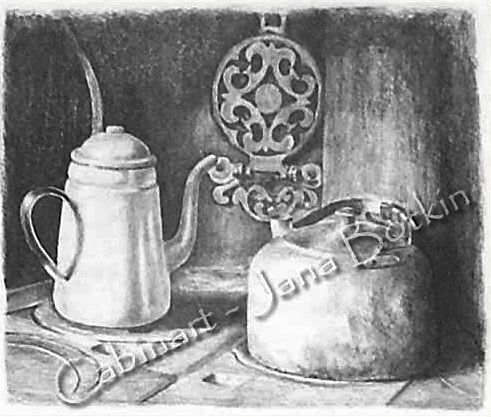
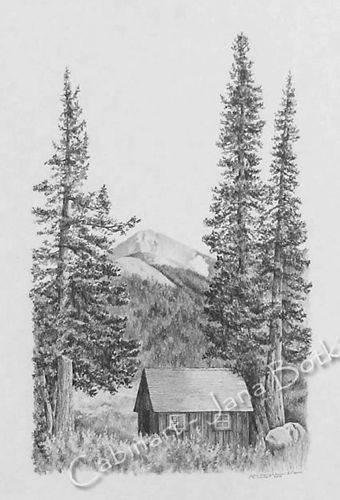
This was drawn using the entire range of pencils available.

There have been many art teachers in my life. Each one seems to have hard and fast rules that they insist apply to and be followed by everyone, or at least by all their students. Since I teach drawing, I understand this, but I try to clarify the reasons for my rules so that the students can decide for themselves.

One colored pencil teacher said to ALWAYS put the darkest color as the bottom layer and work up to the lightest color. (Gary Greene) Another said ALWAYS start with the lightest color as the base and then add layers in order of increasing darkness.(Ann Kullberg)  I have done both on the same drawing and gotten the same result! Other times, there is a difference, and I don’t know why.

Several colored pencil teachers have said NEVER USE BLACK. If you want darkness, build it up by layering the darkest colors. When I do that, it rarely looks dark enough but instead, looks as if I layered the darkest colors because I couldn’t find my black pencil. When asked about this bad black pencil theory, a different teacher of colored pencil simply said, “If you aren’t supposed to use black, why do they manufacture it?”

Some of the painting teachers I have listened to say “NEVER use white alone”. (What color is one supposed to use if white is the needed color??)  Most say, “NEVER use black”. I spoke to a professional painter whose paintings sell for more than my car is worth. He told me of his layering process and it included black paint!!

The best drawing teacher I ever had only let us use a 6B pencil, which is very soft and dark. We could not smear or blend with any tool, including our fingers. His premise was that if you could learn to control that one pencil, you could make any pencil do anything you wished it to do. He was right, but then it took me years to be able to use the entire range of pencils available because his idea was so deeply etched into my head.
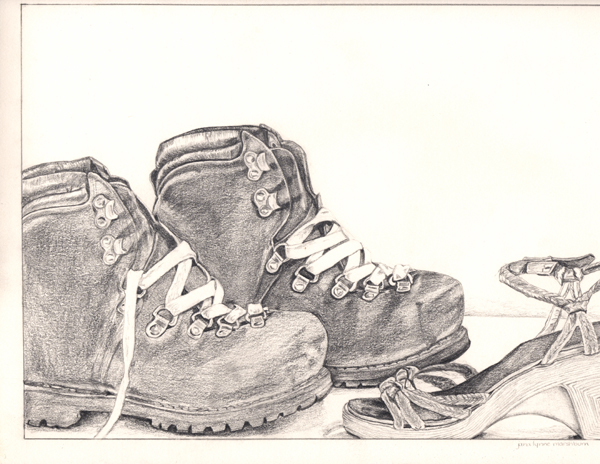
This is a piece done under the guidance of Professor 6B.

Many of my students ask how to hold their pencils. I show them how I hold mine, and tell them to try it, and also to try anything that feels comfortable to them. As in handwriting, everyone has a different look to his drawings. The point is that there are many places in life where there are rules, but in art the only absolutes are determined by the results you desire.
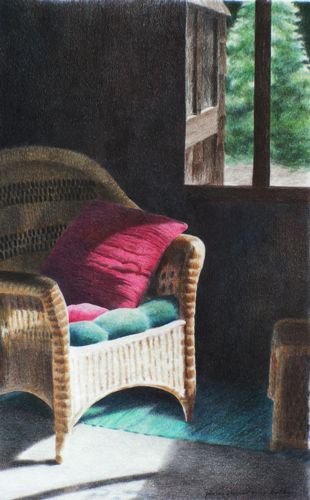
Thinking About Facebook

A Thinking Place, 11×14″, colored pencil

In the fast-paced, always-changing high-tech world we occupy,  there are decisions that need to be made. By not making a decision, a decision is still made. (And some people think I just stand around painting all day, lah-lah-lah, happy little idyllic pastoral groovy life!?)

I’m trying to decide if Facebook is a good idea or a bad one in terms of business promotion. If you are on my email list, you received a request for your opinion on the subject. The number of responses was wonderful – honest, helpful, informative and abundant! And I was able to respond privately to everyone of you with real gratitude in my heart.

I love the personal and immediate nature of email. In snooping around Facebook (some of the pages are visible even without an account), it seems as if the nature of communication is quite shallow. Of course that could be due to the fact that the pages I saw are not private!

Here are some of my conclusions from the feedback you provided.

  1. The correct term is to “be on” Facebook, not to “use” it.
  2. I am an ICG, not a DBO, and the correct spelling is “Okie” because “oakie” is a little tree. ICG means “Ivanhoe Country Girl”.
  3. About half of you are on FB
  4. Most of you are on FB just to stay current with family, particularly newly grown children or grandchildren.
  5. The staying current consists of seeing photographs rather than having conversations.
  6. More women than men are on FB.
  7. They are not “sites”; they are “pages”. (It IS called “faceBOOK”)
  8. Very few have ever visited a business’s FB page; if so, it was for coupons and freebies.
  9. A business page has “fans”; a personal page has “friends”.
  10. There are many privacy options to be learned and used.
  11. If the page isn’t updated daily, people lose interest.
  12. Many of you offered the help of your sons, daughters, nieces and nephews, all of whom are quite good at this sort of stuff. I thank you!!
  13. A participant can quit any time. (like smoking or drinking??)

New and Improved

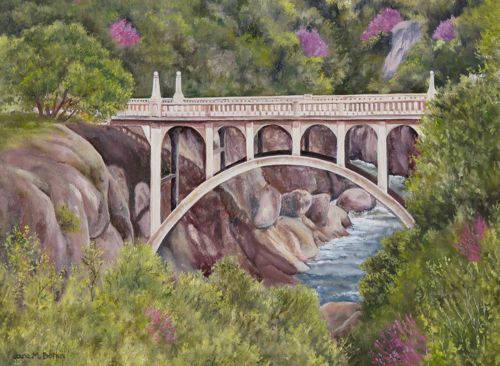
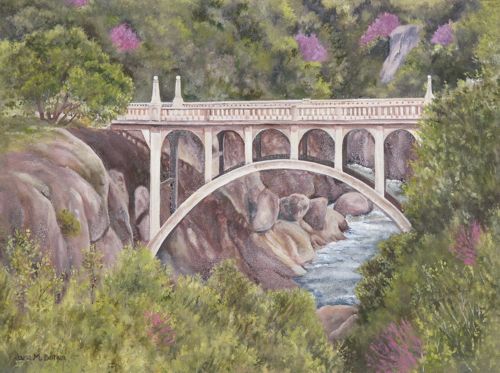
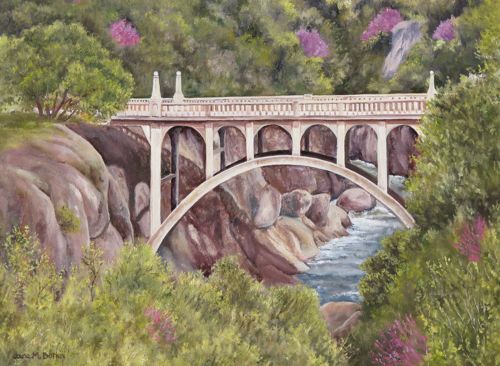
Learning, learning, always learning. When I stop learning, I will be dead! Here is my current personal painting lesson (and I may be the “meanest” teacher I have ever had!) If you are a regular reader of this blog, you will know that I love this bridge to the point of ridiculousness. Apparently I am not alone, because each time I draw or paint it, it sells. The most recent version hasn’t sold; because I know the subject is a winner, I had to take a hard look with my most critical attitude at the painting. Without going into specifics, look at the Before version:

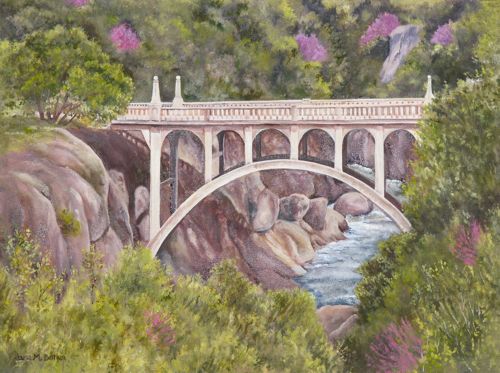
Now look at the After version:

Now that I have seen it on my screen, I can see that my lessons from this painting aren’t over yet.

Okay, now maybe it is finished. Maybe. Perhaps. I’ll let it mull awhile longer.

The Elephant, again

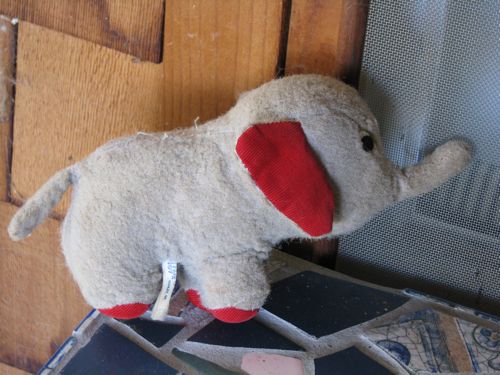
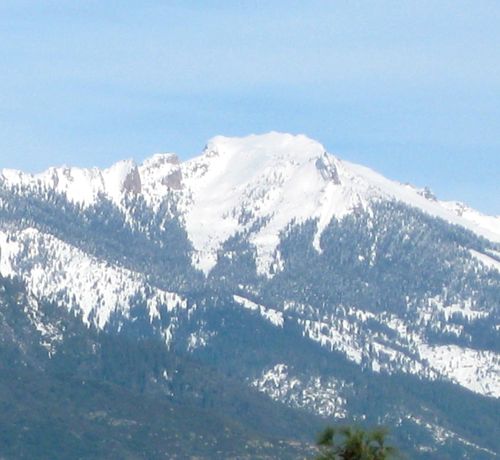
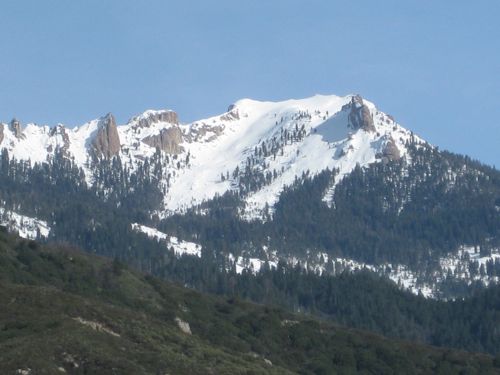
A friend told me she was having a bit of trouble seeing the elephant on Alta Peak. With a little help from my very old buddy, I’d like to give her a hint:

Despite the fact that my little buddy’s trunk goes up, there is a remarkable resemblance! (MM, did this help you?)

What to Draw

This is the third article in the series, Thoughtful Thursdays.

Were you ever given vague art assignments in school? The ones I remember the most vividly were generally focused on ways to use different media, and somehow the students were expected to be instinctively creative enough to come up with an idea to illustrate the teacher’s inadequate instructions. “Show transparency” “Design a container for air” “Make a self-portrait but don’t draw your face” (as if we could draw our own faces at that point!)  In addition to terrifying us, those assignments instantly caused the problem of WHAT to draw or paint or sculpt. Endless thumbing through magazines provided by the teacher only occasionally solved the problem of WHAT (never mind the copyright issues!)

Now, I hear similar woes from my drawing students. “Oh no, I’m almost finished and I don’t know what to draw next!”   I watch them struggle through piles of photos to find an image to draw and remember that awful feeling of a blank mind.

Part of the struggle comes from something I tell everyone who draws with me: pick something you LOVE because you will be staring at it for a long time.  This is much harder if the only photos available are from someone else. How is it possible to love something that represent another’s experiences?

The older we get, the more we experience, and it is precisely this experience that gives us the ideas.   Now that I am at the 1/2 century mark, the ideas are overwhelming me! Everything I see, every place I go, ideas are flooding into my brain. Nothing in my life is exempt from consideration for a drawing or painting. The only necessary filter is the consideration whether or not anyone else will like it, because if my art doesn’t sell, I will have to get a job!

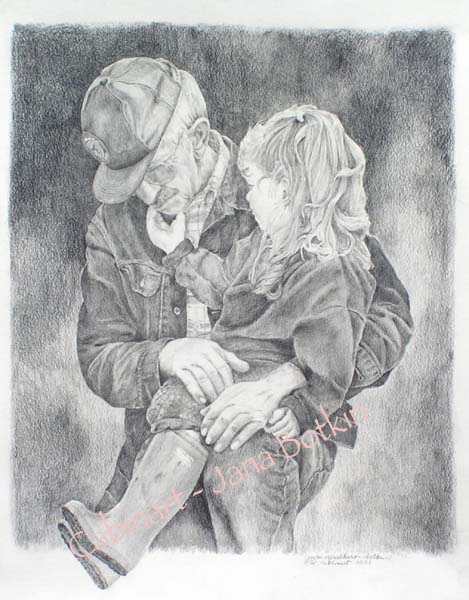
If making art is part of your life and you find it difficult to choose subjects, remember to examine all your life experiences, surroundings, views and belongings. When you encounter the parts you love, you will have the beginnings of a piece that you will enjoy spending time on, which ultimately translates to a good piece of art.This is my dad with his great-niece Claire, who had just lost her grandpa. I drew this in the year after my Dad died, and was somewhat fearful that I’d cry the entire time. Instead, it felt as if I was spending time with my Dad every time I worked on the piece.

How Many At Once??

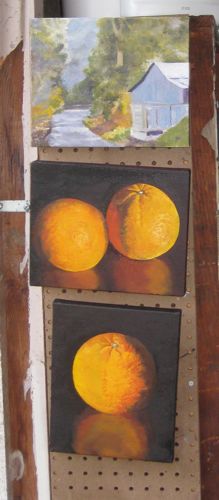
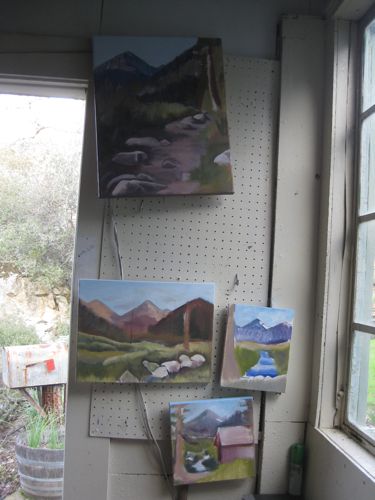
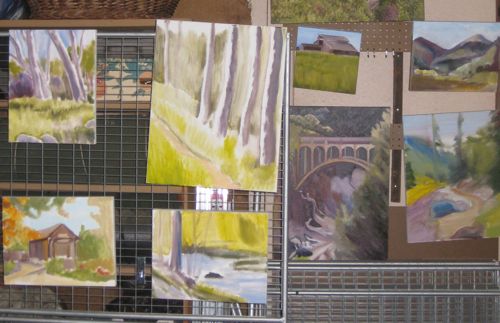
This many! If you compare the photos to those in the January 13 posting, progress is evident. It is a bit random, as I choose what to work on based upon 2 things: degree of wetness and colors already mixed on the palette.

Hospital Rock: A lesson in choosing photographs for art

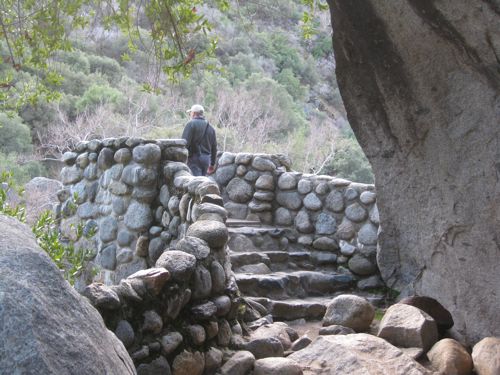
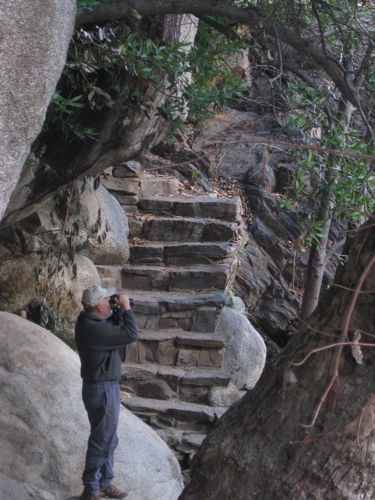
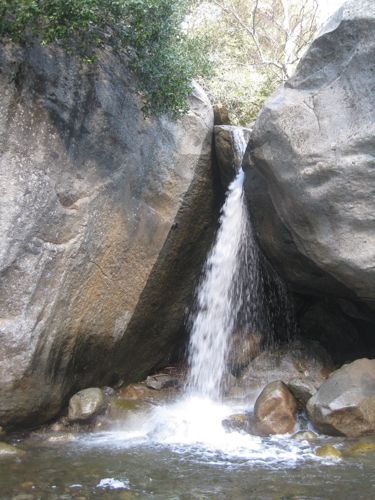
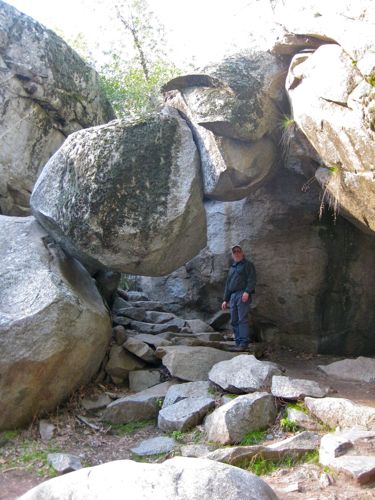
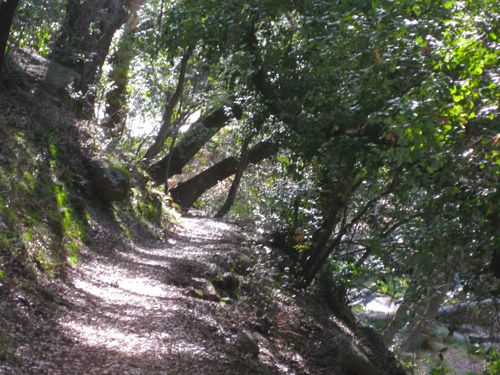
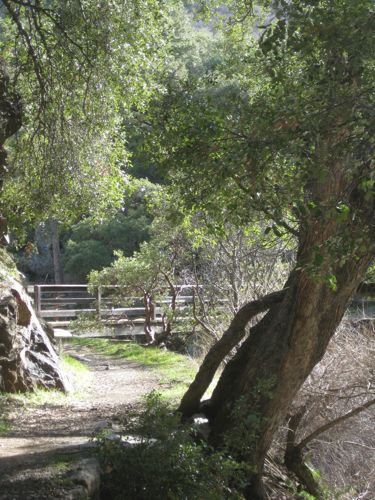
In what passes for winter in Tulare County, sometimes it gets cold and gray. Count on it in the flatlands. Moan and complain about it in Three Rivers. If you’re smart, you’ll just drive up a ways and voila! Sunshine! That is what Michael and I did on Saturday. Ever been to Hospital Rock? I had, but only to the upper parts and not to the river. The interesting thing is this: I recognized the rocks because I have drawn them! As always, I was looking for light but seriously distracted by the lovely old rockwork. Under the photos, I will put my opinion of how each photo would be useful to an artist.

There was a bridge across the river (middle fork of the Kaweah) until it washed out in the ’55 flood and a wall was added for a viewing platform. This has the clear detail necessary for a pencil drawing, but probably not the best choice of subjects because it is sort of an odd structure. Those sorts of things make sense in photos but cause an art viewer to wonder what the heck it is!

There are inexplicable stairs all around. Clearly this was constructed in an earlier era before evidence of humanity was forbidden (except signs with cautions and warnings.) This has good clear detail for a pencil drawing, but not a great one because there is no visible sunlight. The person could be included or left out, depending on how much fiddly detail one wanted to do. If the face was showing, I’d say FORGET IT – NO FACES SMALLER THAN AN EGG! (ok, I might not shout, but I’d be very adamant on this point.)

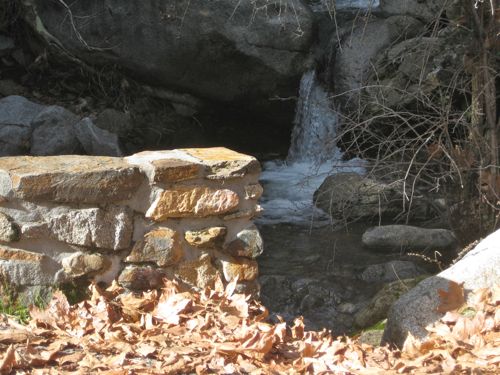
I recognized this little waterfall – it had my friend’s parents standing to the left in the picture that I drew. This would make a nice pencil drawing –  great contrast but not enough color for a painting.

Would the Park allow a trail to be built beneath a rock like this now?? Would they even allow the rock to remain? There are no warning signs – amazing! This photo is good for documentation only – the subject is too weird for art.

This is the kind of light I look for. It would make an excellent painting. Also good for drawing but it would be hard to render the textures unless artist is very experienced.

The Paradise Bridge was replaced in the early ’90s (Michael worked on that project) and it washed out in the ’97 flood, which was only about 1/4 of the water experienced in the flood of ’55! I wasn’t born yet. (Just had to throw that in in case you were wondering.) This would make a drawing and maybe a painting but I’d have to think about what to do with that heavy-looking tree leaning out to the right.

Hard to imagine it washing out. This photo is good for documentation only.Too much texture and the main subject is too small for a good drawing. In case you are wondering, I learned this the hard way. 

Rockwork, light, this would make a nice pencil drawing. Maybe even colored pencil. Maybe a combo! I’d mess with the composition a tad to get the edge of the wall off dead-center.

What do you think?

Forgive Us Our Trespasses

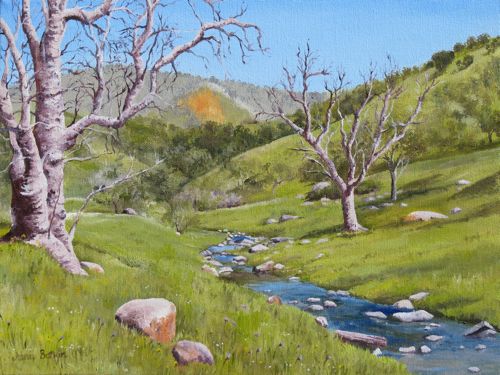
This is 16×12″ oil on wrapped canvas. It represents 2 days of exploring Yokohl Valley last March at the height of wildflower season. I spent an inordinate amount of time on it, and almost had to break out my blow dryer to have it dry in time for the show! “Yokohl Valley Revisited” at the Tulare Historical Museum opened last night.

The title of this paintings has 2 meanings: a fair amount of trespassing was involved in gathering my photos. Number two: in the Bible “trespasses” means sin; I think it would be a sin to turn this gorgeous place into a city. I can just hear my Very Wise Dad saying in his overly calm voice meant to soothe but also a bit infuriating, “Everybody has to live somewhere.”

First Things First

Second in a series called “Thoughtful Thursdays”

Living in a beautiful place often inspires people to create art. Lots of people get the yen to paint, often when retired. (Sometimes I have to bite my tongue to keep from saying, “Oh yeah? I think I’ll try practicing law when I retire!”) Most don’t understand that drawing comes before painting, sort of like grunting and pointing comes before public speaking.

A painting without drawing skills behind it is usually a weak piece of art. By “weak”,  I mean weird shapes, bizarre perspective, and lacking in contrast. Unless one can see proportions, perspective and understand values  and composition, the resulting paintings will most likely be exercises in frustration. Throw in color, paint consistency and brush behavior, and you get a recipe for visual chaos. (Of course, if one is more process than product oriented, poor paintings may not be considered a problem.)

Drawing is a skill that can be taught, learned, and developed through repetitious practice. I have been teaching people how to draw for 17 years and always tell beginning students “drawing is a skill, not a talent”. It is like typing – everyone can learn to type. Some type 25 words per minute, and others hit 90. Those speedsters are the ones with talent, but all are typists.

Despite knowing the proper sequence of skills, I do understand the desire to just dive in! When I was learning to knit, my attitude was “Scarves? We don’t need no stinkin’ scarves!!” My first project was a sweater, and not just a simple pullover but a cardigan, complete with button bands and button holes! Needless to say, I own many weird sweaters, and, after almost 6 years of knitting, quite a few good ones too. So, it is probably possible learn to paint without first drawing, if one is learning from mistakes in the process rather than just cementing bad practices. Of course one must also be willing to have a collection of weird paintings!

Musicians, particularly pianists, have to practice like crazy. They play lots and lots of scales, repetitious exercises, picking apart songs line by line, phrase by phrase, note by note. Artists sometimes forget to practice and treat each new piece as if it were the performance of a lifetime, or thinking in athletic terms, an Olympic event. Practice, practice, practice. This is how you learn to draw and to cement those skills of proportion, perspective, value and composition.

The drawing above was done when I was competent in my drawing skills. This painting was my first attempt at the same subject  when I was brand new to oils (try to be polite!):

Here it is again after 3 years of practice with oils (and I’m sure it will look hideous to me in another 3 years!):

It is all speckled because I photographed it wet in bright sunlight and the sun reflected off the texture of the canvas. Photography is another skill that requires training and practice!

Cranking Up the Painting Machine

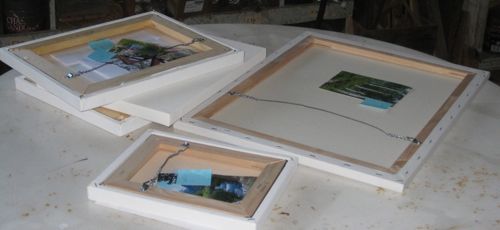
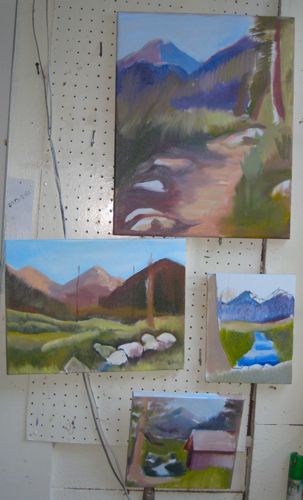
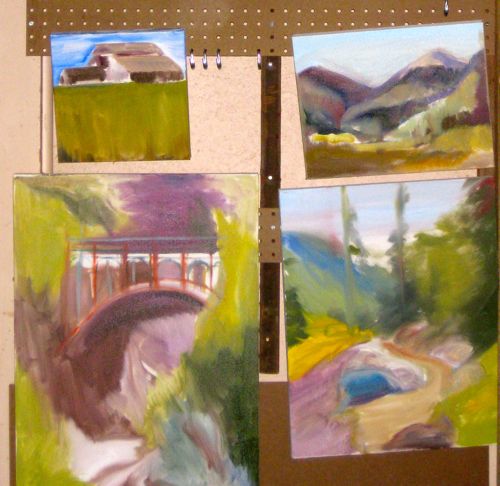
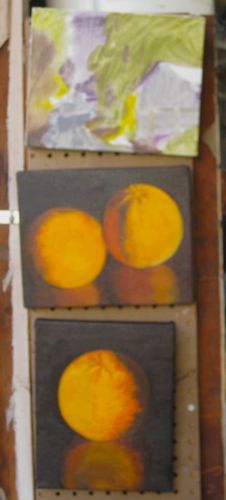
That would be me, the Painting Machine. I’ve spent the past several weeks evaluating my inventory, thinking about subjects that might appeal to a flatland audience, analyzing my photos and asking others to share their opinions on a pile of pictures. After making decisions about subjects and sizes, putting the hanging hardware on the backs of canvases, assigning inventory numbers and titles, and adding them into my inventory lists, today I finally picked up my paintbrushes! This is how things look right now; think of this as a sneak preview into a solo show that is coming for me in May!