But Wait. . . There’s More!

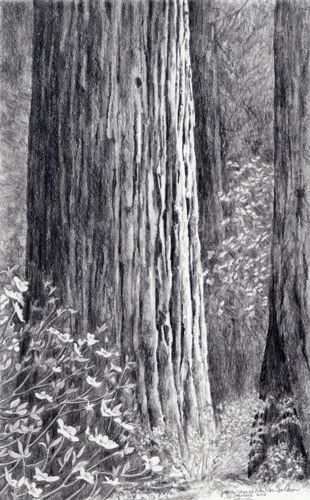
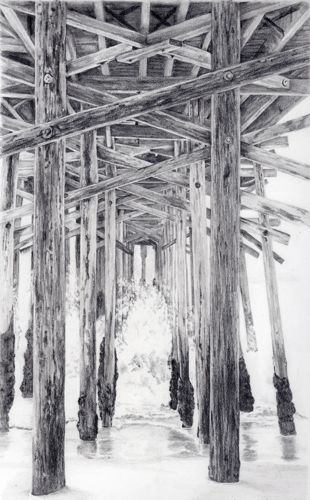
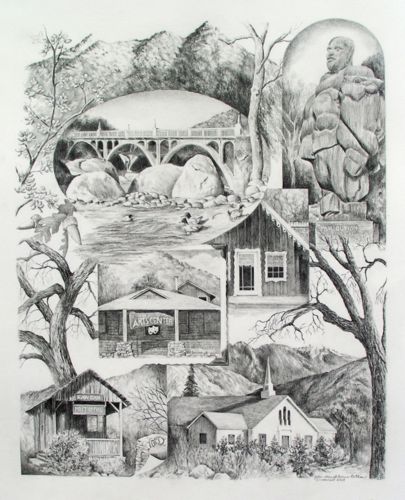
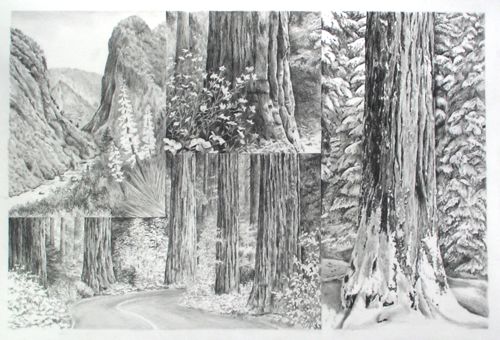
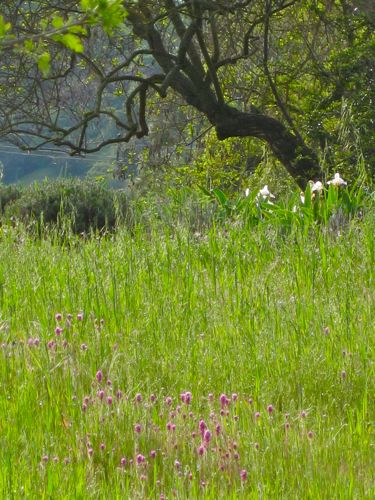
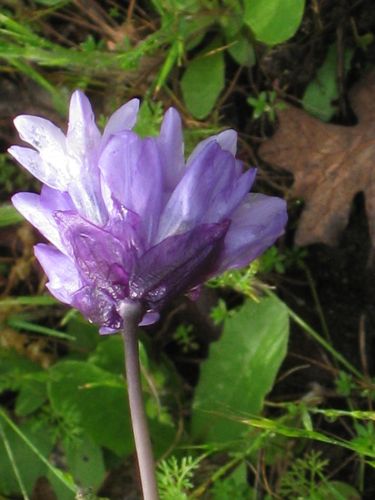
These 2 “$4 Lawn Job” pieces will be in the Richeson 75 exhibit. I am a bit puzzled over why the bridge is in the book but not the exhibit and these 2 are in the exhibit but not the book. Life is full of mysteries!

Redwood & Dogwood, 9-1/2 x 6″, pencil, $400

Wood, Wind, Waves, 11-3/4 x 7″, $500

$4 Lawn Job, Part 4

Our lawn mowing boy spent a fair amount of time thinking about what Mr. Persnickety told him. “No one has ever done a $4 lawn job for me.” He decided that he would be the first. I’ve forgotten much of what the boy did, but it did involve some sort of a roller device to flatten any slight bumps and there was a nap in the middle of the day so he could continue on in the afternoon. When he had finally exhausted every possible method of perfecting that lawn, he knocked on the door and announced to Mr. Persnickety that he had done a $4 lawn job. Mr. Persnickety was skeptical and began inspecting his work. After going over every inch of his yard, he agreed that the boy had indeed accomplished the impossible and he paid him his $4.

What does that have to do with my art? Hang on, I’m getting to that part! You may have noticed that I don’t participate in many competitions or shows that are juried and judged. Earlier in my career, I tried those. After several rejections, (one show was a consistent winner – Madera Arts Council Ag Arts) and after reading a great deal about ways to build an art career, it seemed best to just focus on the local market.

Then, along came the Richeson 75. This is the first show I’d heard of that separates dry media from oils from wet media, which means pencil isn’t competing against painting.  Something told me to try this show, and I knew I was facing my own $4 lawn job challenge. (REALLY! That is how I thought of it!)

First, I chose my best subject and found the best possible photo of it. Then, I cropped it to the Golden Rectangle proportions, drew it carefully, shaded it, took it to my students to evaluate, layered a bit more, lightened here and darkened there, put it under a magnifier and sharpened all the edges of the bridge, studied it, changed a few things, and finally, sent it to the Richeson 75 in the Landscape, dry media category.

Rappity, tappity, bingety, BANG, BOOM!!! chhhhhhhh (that last noise was a cymbal.)
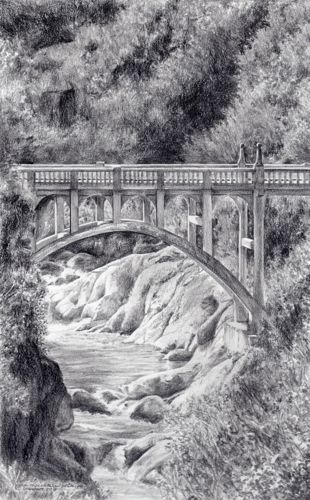
Rural Dignity, pencil, 6×9-1/2″

It will be in the exhibition book for the Landscape, Architecture and Seascape 2011 show!!
$4 Lawn Job, part 3

Our lawn-mowing boy in the story was satisfied with the $2 job for awhile, and then decided to see if he could do the mowing job for $3. This time he mowed carefully in one direction, then mowed carefully in the other. He probably trimmed the edges and dug out some weeds. It took a bit of fancy talking, but he convinced Mr. Persnickety that the job was indeed worth $3.

When I read the story, I couldn’t figure out how he could possibly improve on that massive effort at perfection. I thought he ought to be satisfied that he was able to do a $3 lawn job; after all, Mr. Persnickety had warned him in advance that no one had ever done a $4 job in the history of hiring neighborhood boys to mow.

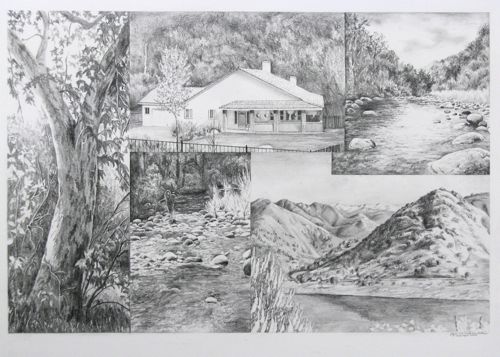
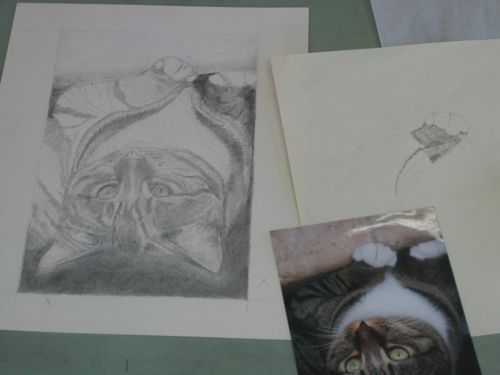
This is just how I felt when I began drawing collages. It took a long time to plan, a long time to lay out, and a very long time to shade. Didn’t seem as if there was any place to improve after that!

$4 Lawn Job, Part 2

After our boy in the story mowed the lawn, he went home to puzzle out how to earn $2 next time. After some thought, the second time he mowed he probably went over the lawn two times, a bit more carefully and perhaps in 2 different directions. He told Mr. Persnickety it was a $2 job, he was paid, and both were happy.

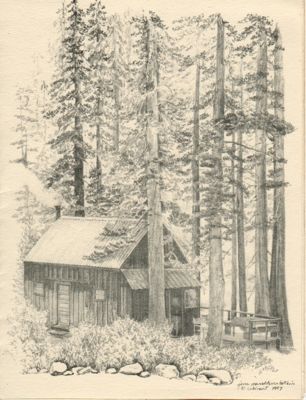
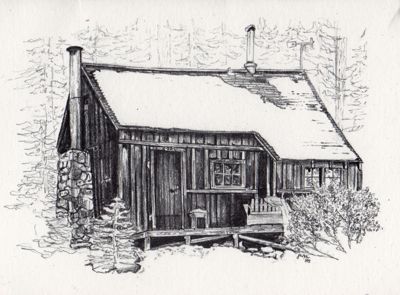
In comparing this story to my drawings, this is my version of the $2 lawn job. Still have pencil, desire,  and skill. A neighbor/friend/customer suggested that I back up and show the cabin in its setting. (Thanks, Janey!) I was a bit worried about tackling trees, but knew I could figure it out with enough practice. Eventually I got comfortable with the added “growies”.

$4 Lawn Job, Part 1

There is a story from my childhood about a boy who went to a neighbor looking to earn money. The neighbor, whom we will call Mr. Persnickety, said he could mow the lawn. The boy was to supposed determine if he had done a $1, $2, $3 or $4 job and tell Mr. Persnickety. If the man agreed, he would pay the boy that amount.

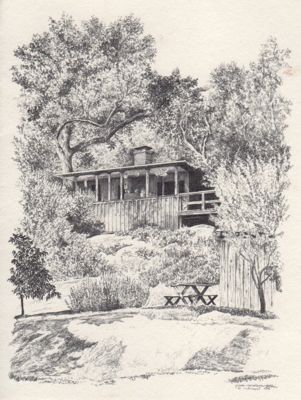
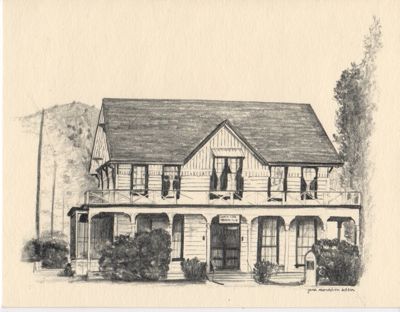
I’ve never forgotten the story. In applying it to drawing, my early work would be the $1 job. Have pencil, have some skill, have great eagerness, will draw. It is probably the equivalent of making one quick pass across the lawn with the mower. Here are 2 of my early drawings. I had no idea how to handle trees or shrubs, and if someone asked me to draw a building, I drew it. Just it. Nothing else but it. Start at the beginning, finish at the end, sign, get my dollar and go home.

Optimism in a Garden

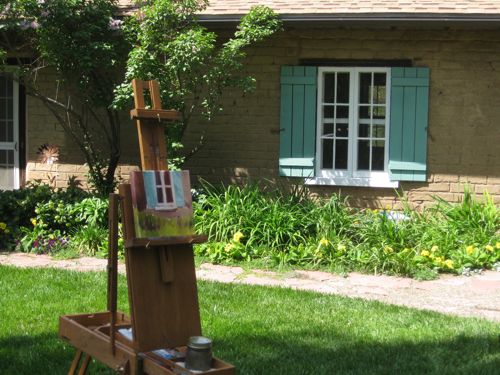
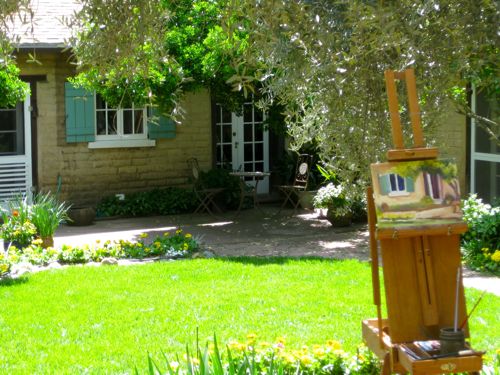
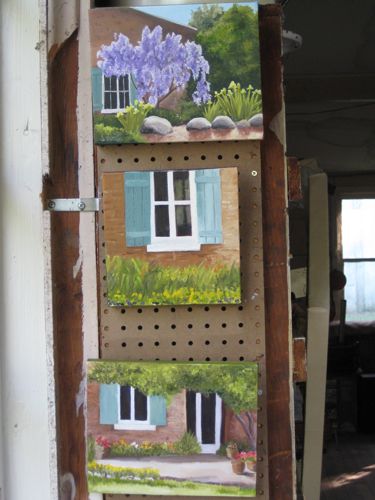
The Hidden Gardens Tour was a booming success on Saturday. Zillions of people came, and the weather was perfect. I was supposed to be painting plein air, which means “on site”, but really probably means “OHMYGOSH This Is Impossible”. I did paint but probably more words were spread around than paint was applied. Wow, what a gorgeous place I got to be!

The plan: take photos in advance, and do the first pass over the canvas of about 8 paintings. On site, move about every 45 minutes and work on a new painting. By the end of the day (a five hour time chunk), have 8 paintings almost completed. (Please don’t hurt yourself laughing nor snort coffee out of your nose onto your computer)

The reality: 1 painting finished in advance of the day, 2 sort of finished during the 5 hours. changed location once. Lots of conversations, visiting with old friends and making new ones, lots of just dabbing at the canvas thinking “I’ll just have to fix this later”,

Some people asked if it was my place – I said “In my dreams!”One woman asked me if she could use my bathroom –  I said “Sure, but you’ll have to walk a mile to get to it”.  It was just a very very nice experience, and when it was over, my feet hurt but my heart felt happy.

The 2 lower paintings got sort of done-ish, and the wisteria was completed last week.

The Real California

This week you’ve seen some beautiful green and flowered photos of Three Rivers. These are the sights that inspire this California artist, and I love sharing them with you.

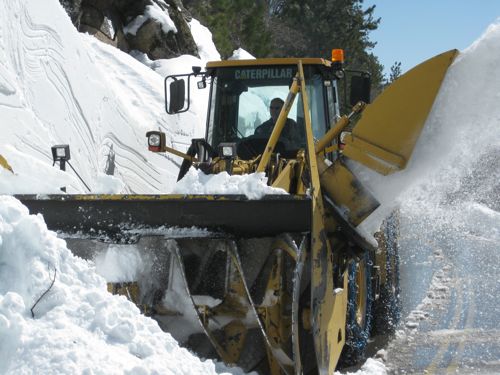
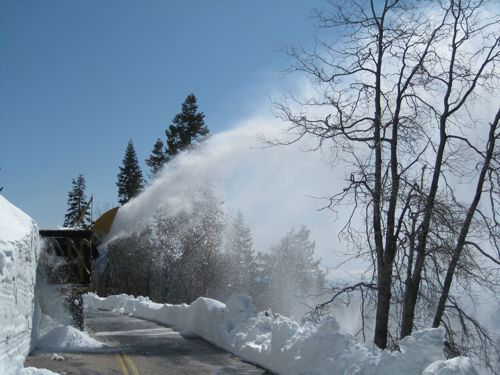
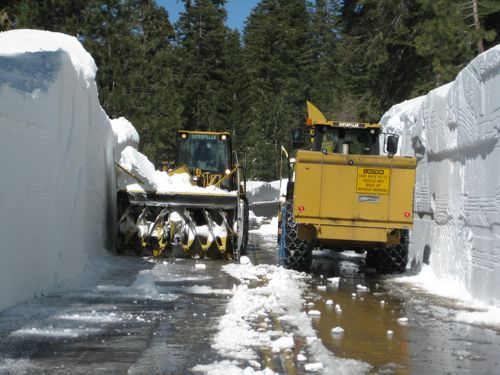
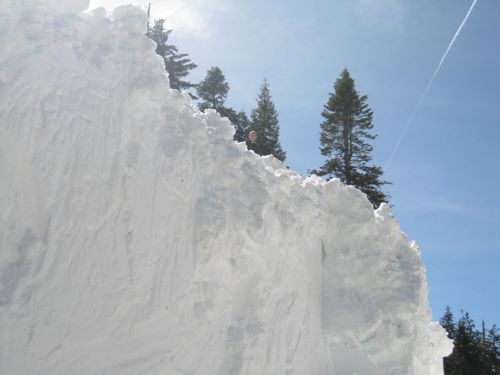
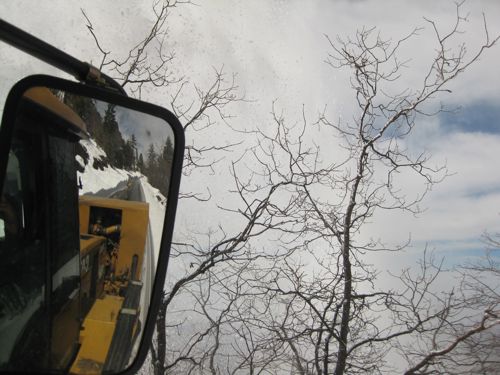
While I am working in the green hills, my other half is at a higher elevation with an entirely different climate and color. Every work day, he puts on green pants, drives an hour up a gnarly road (or more, depending on conditions and an endless construction project) and climbs into a yellow machine to fight the white snow. (See how I think in colors?)

He doesn’t always work alone. And in case you are wondering, the square thingie on the back of the Big Yellow Machine on the right is called the doghouse.

That’s our friend John up on the snow bank. He is the co- owner/publisher/reporter/photographer of the local paper. He went along to photograph the snow removal operation.

And a Third Walk to Remember

Spring is the height of beauty, stunning views, super-saturated color, and altogether inspiring scenes in Three Rivers. When it is taking place, it seems to be the only season that counts. When it is over and I still want to paint it, it feels fake, out of place, inauthentic. That is all the more reason for this California artist to go ga-ga over this glorious time of year! We had a late cold storm last week and the low snow called me out with my little camera.

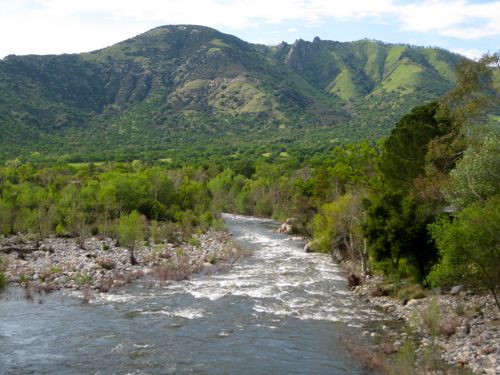
Looking downstream on the middle fork of the Kaweah River

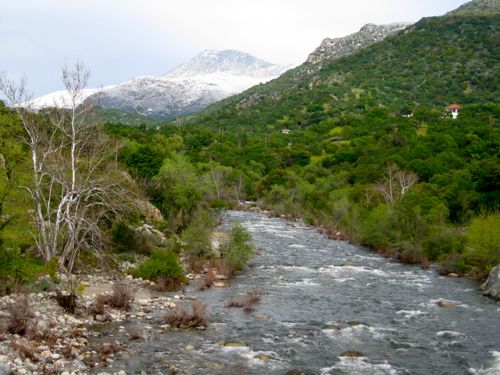
Looking upstream from the same bridge. The snow is covering the foothills; the clouds are covering the real mountains.

One mile downstream from the bridge is the best patch of Owl’s Clover, castilleja something or other.

This is called Dichelostemma  capitatum; I thought it was in the brodaeia family, but my wildflower books might be wrong. Its common name is Blue Dick. I don’t know why Richard is depressed, but he certainly is handsome!

Different Roads

#14 in the series “Thoughtful Thursdays”

Becoming a professional artist takes more than talent, training and desire. It requires a plan, because one’s art can be the best in the world, but if it isn’t seen, it can’t be purchased.

The traditional method of “making it” in the art world is through galleries. An artist can build a professional reputation by entering and placing in juried and judged competitions, and by studying under professionals who are known in the art world. These artists prepare an artist statement and a biography that lists shows, prizes, galleries, professionals studied under,  and other art training.  These types of documents are very important in the formal art world and are often the key to opening doors.

It is more convenient to make it in this traditional manner if the artist lives near cities where shows, master artists, and galleries are available. Since each gallery has its own personality, it can take awhile to find the right match between artist and gallery. Between internet sales and the stalled economy, this traditional road is no longer the automatic route for artists to pursue.

The less traditional method of making it is to be self-representing. These artists seek direct contact with buyers through weekend festivals, commissions, selling on consignment in local shops and by opening their studios to the public. Instead of making art to fit the personality of a gallery, they are making art based on knowledge of their buying public.

These artists tend to have plain speaking loyal customers who say, “I don’t know much about art, but I know what I like!” Their customers might be impressed by shows entered and prizes won, but often are not familiar with the shows. They may find it interesting to know an artist’s training, but usually haven’t ever heard the names over which other artists go gaw-gaw.

Now that the internet provides direct access to millions of people, many artists are following the less traditional route. There are artists who sell all their work through eBay. There are several artists’ groups that specialize in completing a painting per day, and these are selling very steadily. There is a site called Etsy that sells handmade goods, and another called Cafe Press which will reproduce artwork on merchandise for the artist to sell. Most serious artists have a website for direct sales to customers.

In Three Rivers, I know several artists who haven’t found it lucrative to sell in Tulare County; they have gallery representation in cities and are building their reputations by entering shows around the country. There are also artists who prefer to stay local and sell directly to the public. All are friendly, helpful, supportive, respectful and genuinely excited to see one another succeed at earning a living through art regardless of the road chosen.