Have you heard of her? Read any of her books? She writes both fiction and non-fiction and is an odd combination of being very politically liberal and outspoken about her Christian faith. Her thoughts are oh so relatable, shocking, irreverent, vulnerable, infuriating, and at times, highly entertaining.
The books she might be most known for are Bird by Bird, about the writing process and Operating Instructions, about raising her son alone.
Here are three things that I have copied down from her writing to contemplate and muse over on today’s blog post.
“Everyone is screwed up, broken, clingy and scared.” The older I get, the more I see this is true. Those tailgaters? Yep. Politicians? Yep. Your neighbors with the glaring lights and barking dogs? Yep. The cranky salesperson at a big box store? Yep. Me? Hey, let’s not get personal here, okay?
“Try not to compare your insides to other people’s outsides. It will only make you worse than you already are.” Comparison is a terrible way to live. Just stop it.
“…deteriorating faster than you can lower your standards.” This may apply to many aspects of my life. Let’s not talk about the state of my old car, the cleanliness of my house, the number of weeds in my yard, the unsorted piles in my studio.
*Clutter is the physical manifestation of unmade decisions fueled by procrastination. -Christina Scalise
She also has a list called “Twelve Truths I Learned From Life and Writing”, which is one of my favorite Ted talks of all. I used to listen to those while painting and drawing, but now I seem to be continually trying to catch up on all the excellent podcasts I subscribe to.
About those Twelve Truths: she is oh so very wrong about chocolate with 75% cacao.
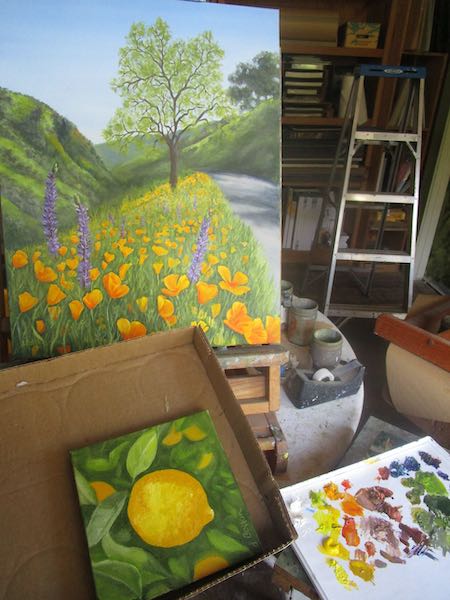
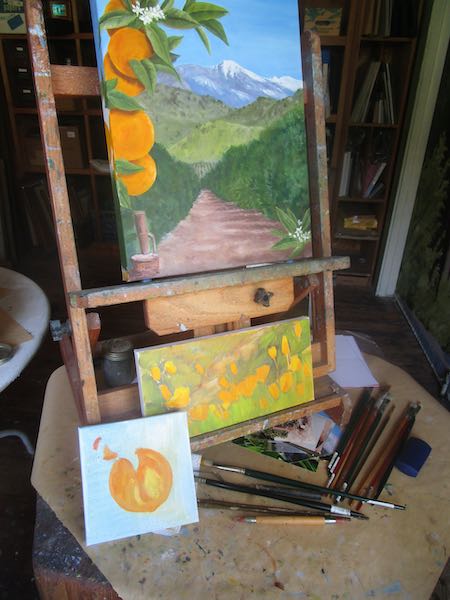
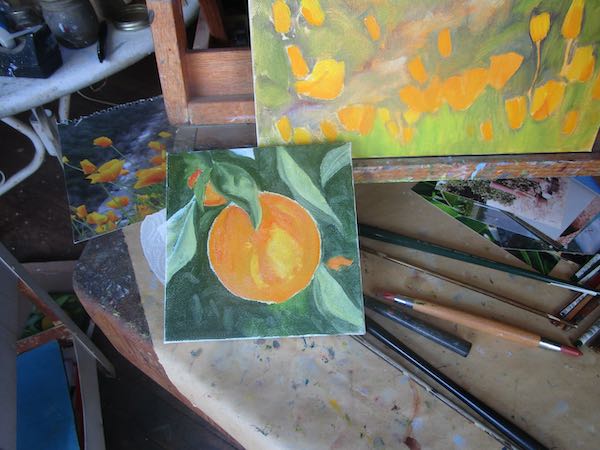
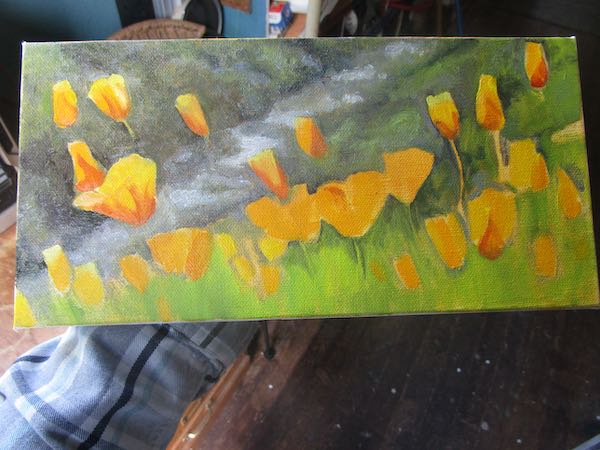
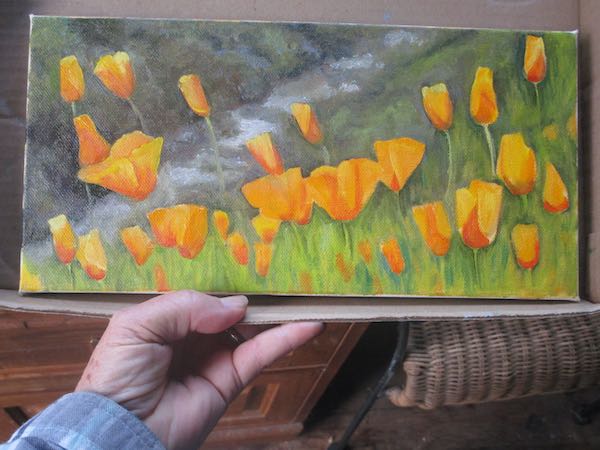
… I am working on several art projects at once. That is, IF I am actually working.
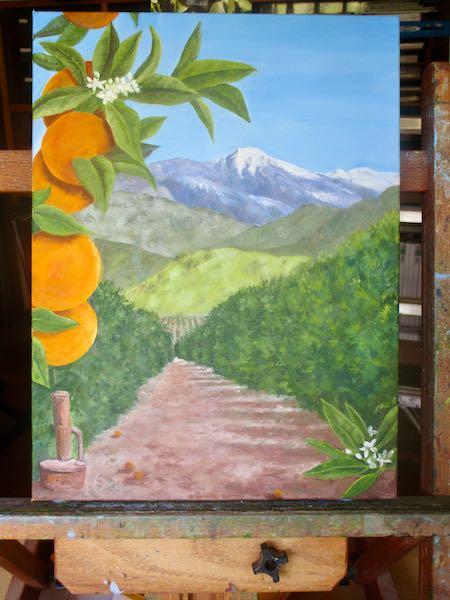
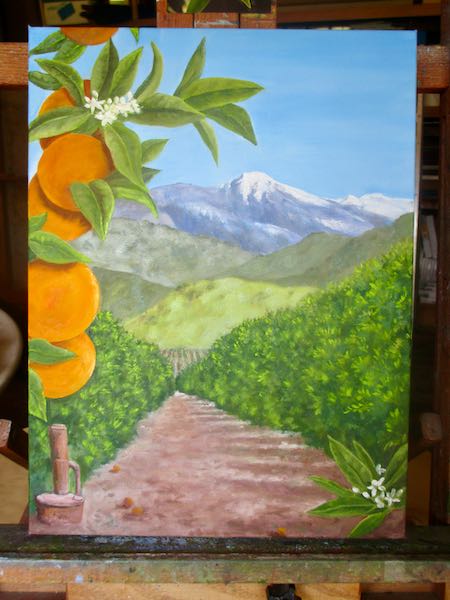
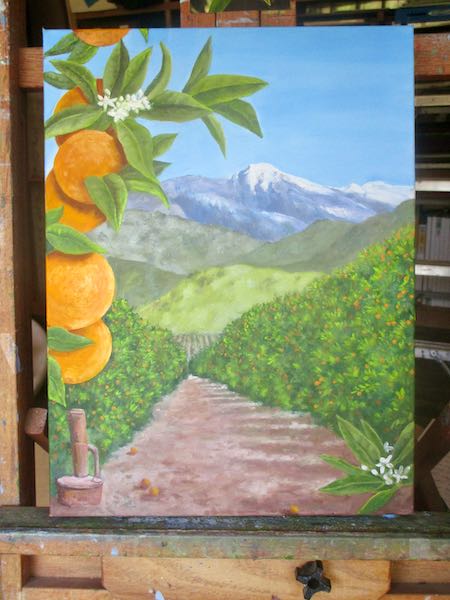
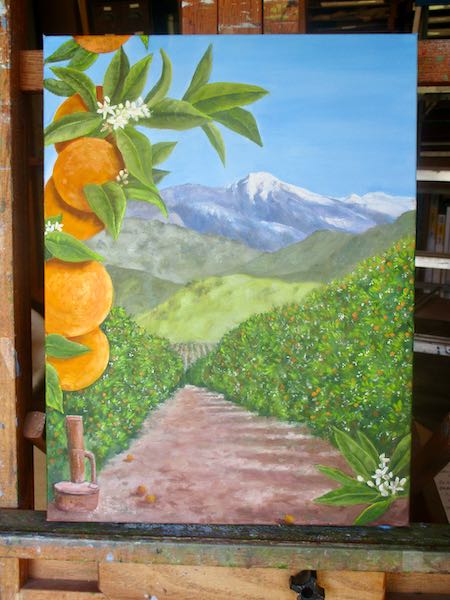
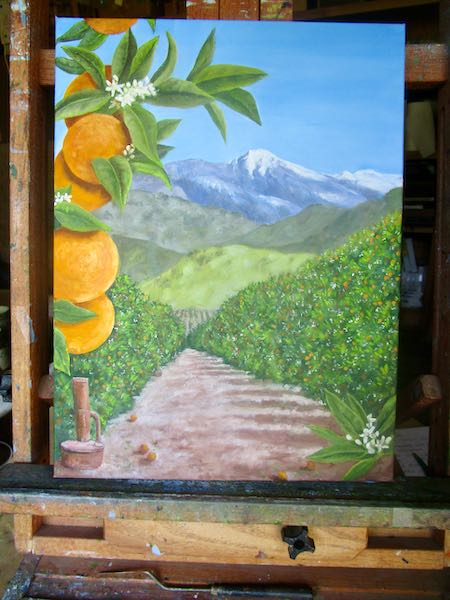
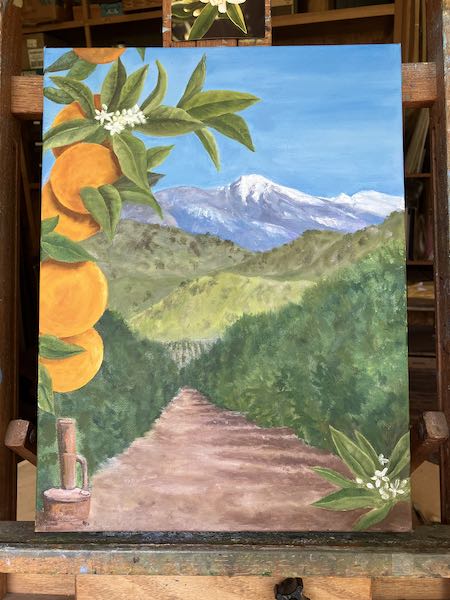
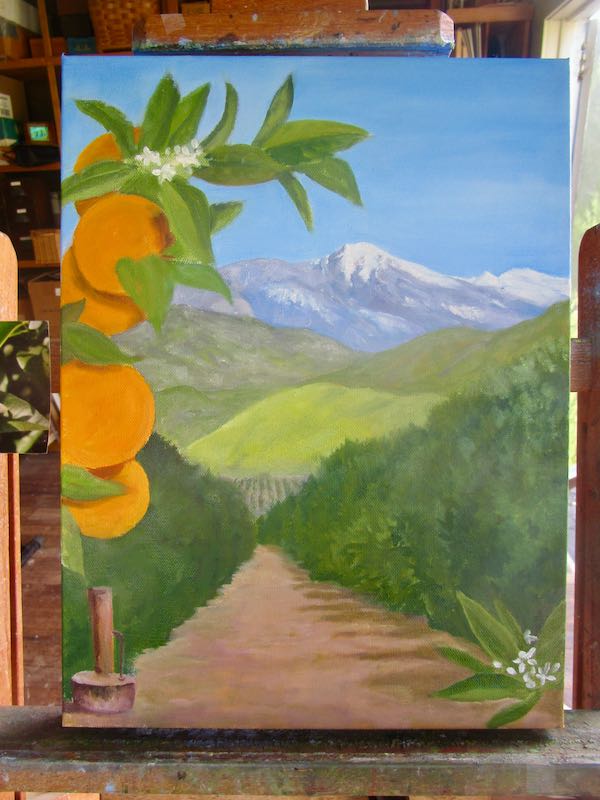
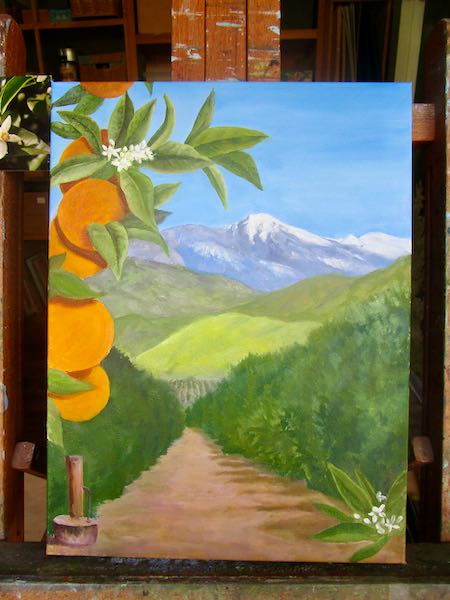
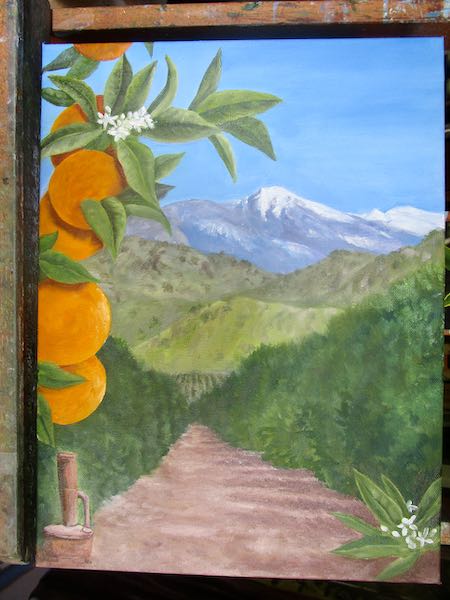
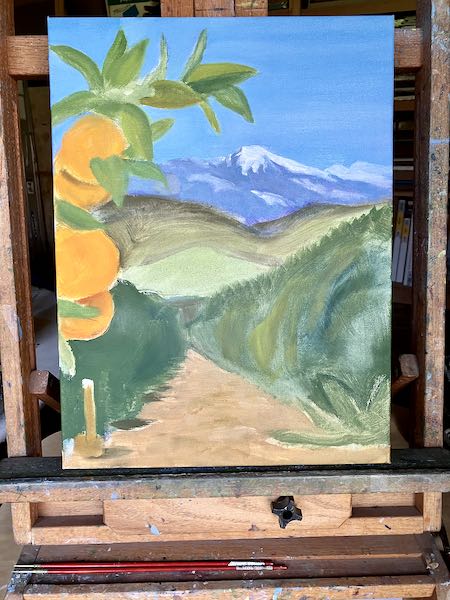
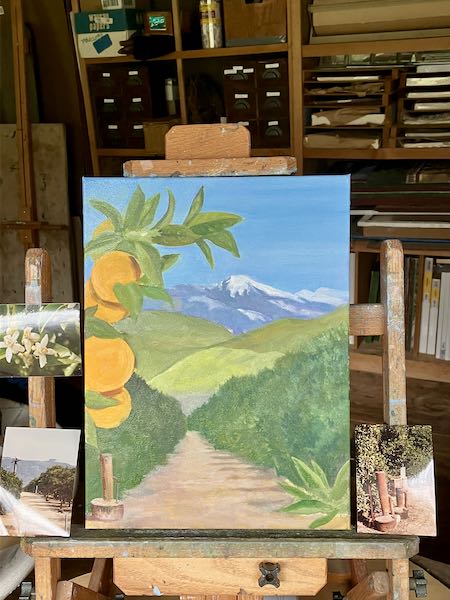
The little beach paintings are still progressing. I have enough boards for twelve of these. Six are now completed, three more are in the messy first layer stages, and three more are waiting for my decision to either paint more beach scenes, or paint some oranges.
I like these little boards.
Pacific Ocean IV, 5×7”, oil on gessobord*, $75
There are also three unfinished oil paintings in the painting workshop, but none have deadlines. The beach paintings don’t have deadlines either, but their small size gives me the illusion of productivity and progress.
Meanwhile, I have two very complicated pencil commissions to complete. One is now in progress; the other is awaiting my thumbnail sketches for the customer to choose from.
“Bad things happen quickly; good things take a long time. This is why patience and determination are such primary virtues.”
I don’t know who said this, but I intend for these two difficult pencil commissions to be good, so they may take a long time.
*Gessobord is something akin to masonite, coated very smoothly with gesso, a thick white paint, probably acrylic.
What is editing? You mean you get paid to just sit around and read??
… I’m either tending to the logistics and administrative duties of a microscopic art business* or I am editing. IF I am actually working, that is.
Yes but it isn’t the same as reading for escape or to learn. Instead, you read with multiple purposes. An editor’s job is to make sure the reader can flow through the book without tripping over the words.
The reading is something like this:
Why do I keep going back to that paragraph? It might have too many words, but for some reason I am not sure of the author’s intent. Maybe it would be clearer like [try a different way of phrasing].
Wait, wasn’t that guy’s name Jim in the last chapter? Then who is Jack? Better do a Jim/Jack check throughout.
Oh-oh, the author is using the tab key instead of indention for new paragraphs; better make sure all those tabs/extra spaces/extra returns get removed throughout.
Eighteen? I thought she was twenty. Where did it mention her age? Better make a note to find all those references and verify the timeline.
Why does this character start every sentence with “So”? This might need a bit of modification. Not too much, because that is how he talks, but if he gets too boring, we might lose our reader’s attention.
Oops, those paragraphs are ragged right rather than justified; better “select all” and choose “justified” so the entire manuscript is consistent. While I’m at it, better make sure hyphenation is turned off or some words will go wonky.
Hmmm, sometimes that word is spelled with a hyphen and sometimes as a compound word. Seek and replace the wrong version.
What am I supposed to do with this list of bullets beneath the heading? Or the bullets beneath the bullets? Wait, is that a subheading that needs to be indented? Does this need to be a new section, or do those words need to be non-bold? If I am confused as to the main topic, the reader might just skip this section.
Semi colon alert! Better watch more carefully.
What is the point of this paragraph? Can it be deleted?
Meanwhile, I am keeping up with the storyline, making sure that it is moving along at a good clip. A problem with editing is that I get caught up in the story and forget to think all those multi-layered thoughts as I am reading.
Sometimes the day goes quickly, so quickly that when I head home, I am surprised that it is dusk. I would be surprised that the cats were put away for the night if Trail Guy didn’t stick his head in the studio to let me know.
“. . . Of making many books, there is no end, and much study wearies the body.” —Ecclesiastes 12:12b
A dear friend told me that she really enjoys my blog posts when I write about thoughts. Here, this is what she said:
Maybe it’s because I’m a worker of words, but I really enjoy your entries that describe your central valley world, your life in it, and your feelings. The reader responses you receive indicate many others do too. I believe getting to know the artist who produces beautiful views of the world beyond our human angst and cultural foibles is an important part of any sale, and I hope you keep posting such thoughts often! I can see them in a book of your own some day. 🙂
Wow. That was thought-provoking, encouraging, and as always from this friend, very kind.
Late one night I had a mental list of ideas to write about. Instead of writing, I went to bed. Now my head is empty, so let’s just have some photographs today with a little commentary.
That giant flowering pear, the last one to hold its fall color, is also the first one to bloom. I took this picture on February 2.My flowering pear is not quite thinking about blooming yet.
There are no words. Well, there were some words, and those were them.
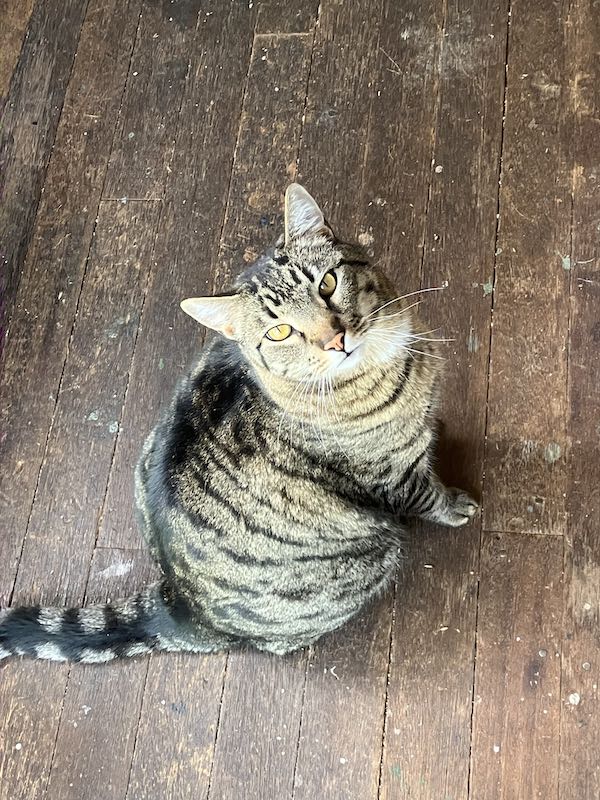
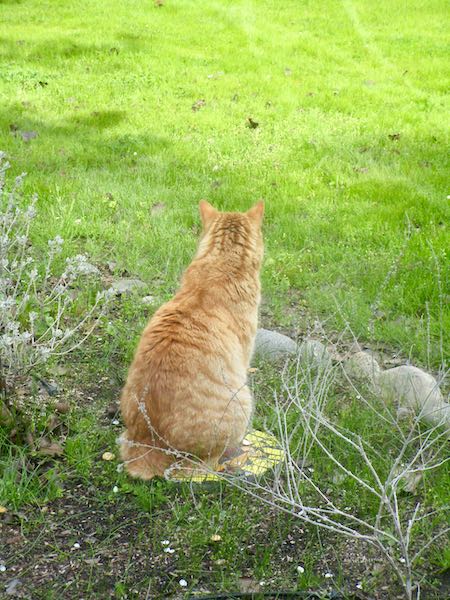
Look at the black stripes on Jackson’s tail: they get wider as they move toward the tip. Made me think about Perkins’ checkerboard tail.
Both cats came from the same place; well, more accurately, Jackson’s mother came from the same place as Perkins.
Linda’s Barn, pencil and colored pencil, SOLD This barn used to be an excellent source of cats, but alas, the Order of All Things has unfolded and we are developing hard hearts in order to cope with the harsh realities of trying to keep cats alive in Three Rivers. (Tucker, Jackson, and Pippin are all thriving at the time of this blog post—thank you for your concern.)
This is what winter can look like in Three Rivers.
Don’t you wish your computer had scratch-n-sniff so you could fully enjoy this rosemary?
Okay, maybe I’ll just sit here for a pair of minutes and see if any of those great late-night thoughts reassert themselves.
There is an excellent museum in Three Rivers, and parked in front are some old fire trucks plus this tow truck. I had to wait for a couple of friends stuck at one of the many ongoing lengthy roadblocks, so I wandered around with my inferior phone camera.
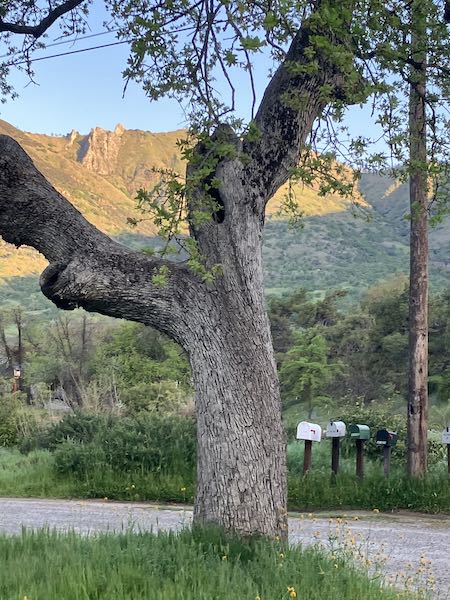
On a recent walk, I took this photo because it reminded me of my painting titled Swinging Oak. You can see it below with a convenient link for purchasing from my website. It’s just business. (I’m tryna earn a living here!)
Swinging Oak, oil on wrapped canvas, 12×16″, $375 (plus tax in California) Available here
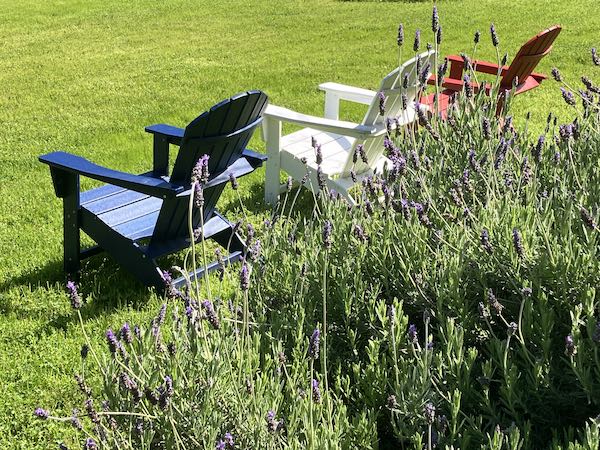
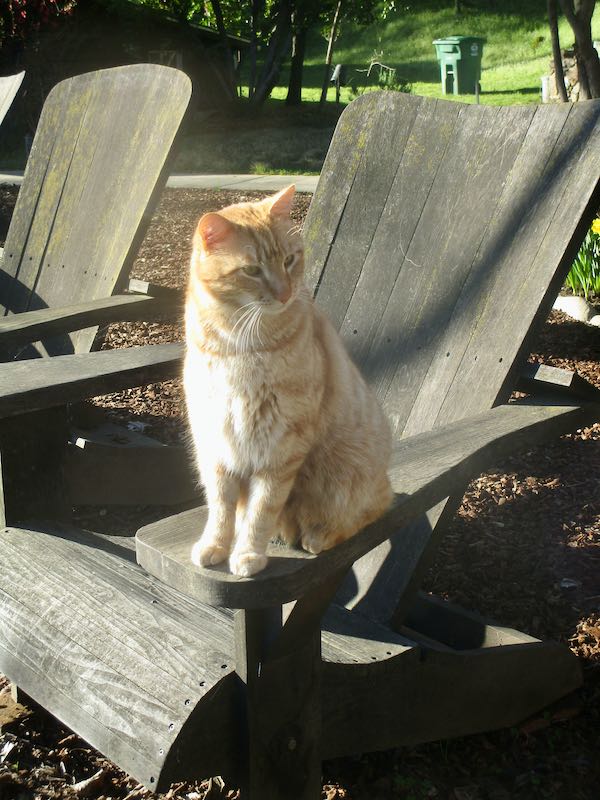
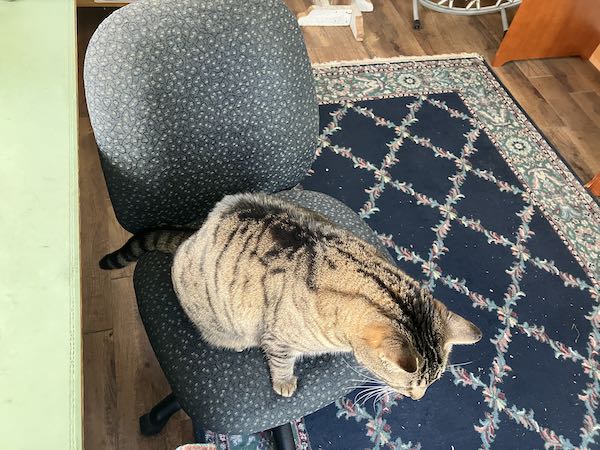
Where’s the other chair?
Why am I not showing you any paintings or drawings? Because I am spending most of my time in the studio, editing another book for another writer on another topic.
A good friend, mentor, and wise man asked me if I have a relationship with my paintings. I wasn’t sure what he was seeking, so I just told him what goes through my mind while painting. Then I looked at the email conversation and thought, “Hmmm, this might be an interesting blog post”.
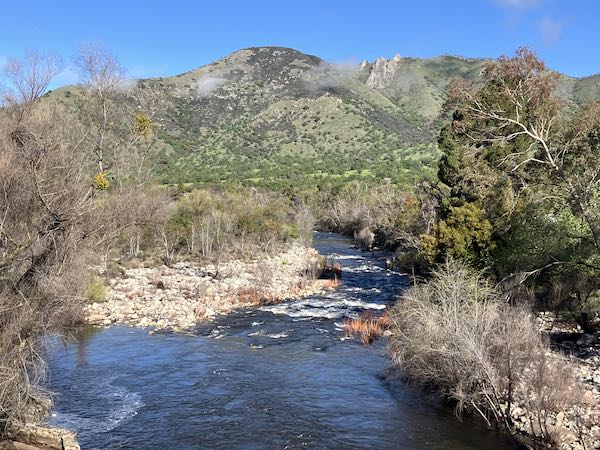
Just a typical view on a morning walk in Three Rivers. Nope, not down those steps to the river—just passing by on the road.
When I start a painting, I have photos to look at, and I copy what is there while also trying to improve on it. Move a tree, brighten a color, ignore a tangle of branches, don’t get too weird about making those rocks or cracks in the cliff perfect, increase the contrast, make that insignificant part blurry or leave it out. . . on and on and on, a continual mental conversation about how to depict a scene realistically but cleaner than real life. Real life is pretty messy, and I try to clean it up.
Often I think a painting is finished when it isn’t. It takes awhile of studying it, sometimes a couple of years, before realizing that it can be improved. This isn’t improvement to make it look more like the photo, but improvement to make it more appealing to the viewer.
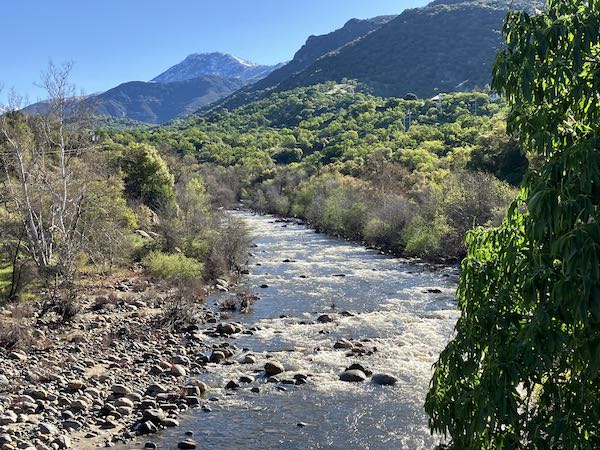
A very popular place to walk in Exeter—and the way we prefer to drive home when the hills are green. I used to walk this in the olden days when I was training for some very long walks, before my feet were numb.
My method of painting is to layer and layer, over and over, tightening the details, correcting the proportions, remixing the colors with each layer. Usually when I start, it is very sloppy, getting better with each pass over the canvas. This is similar to writing, where you tell yourself the story in the first draft. Then as you edit and rewrite, you refine your words, rearrange your paragraphs, realize that something can be misunderstood so you correct that piece, decide that something sounds foggy or stupid or unnecessary so you delete that sentence or phrase. Then you think it is done, until you look at it the next day or the next week or after you hit “Publish” and WHAM! THERE’S A TYPO! Or you wonder “why did I say that??” Or you think, “Nobody cares, why did I write this?”
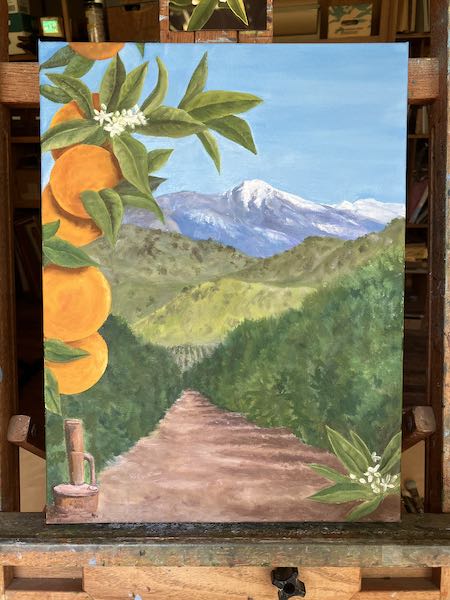
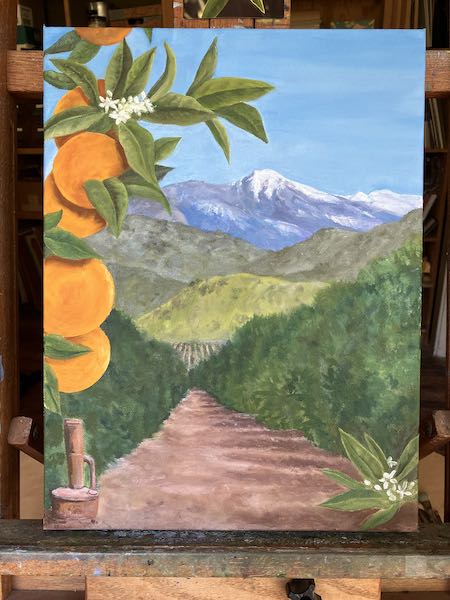
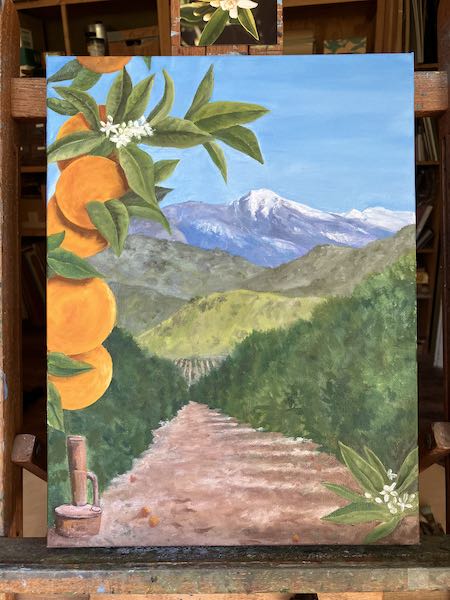
A friend and I went boldly trespassing through some orange groves on a walk a week or two ago.
I’ve never thought about it as a relationship with a painting. It is a project, separate from me. I talk myself through it, talking to myself rather than to the painting. Sure, occasionally I’ve said to a painting, “Buddy, you are toast!” just before painting it out entirely.
But the conversation is entirely to myself—“WHAT are you doing?? Stop licking the canvas! Choose the right color, get it carefully on the best brush for the job, and decide what you are doing before you just dab and jab. Okay, that is looking good, so now do it again over here. Your brush is too small and this will take forever. Whoa, I thought that part was finished and it looks really weak. Oh great, now you’ve missed entire pieces of the conversation on the podcast you are listening to because you were trying to mix a better green.”
So now you know what goes through my brain while I am painting.
Contemplating matters of consequence
With drawing, things are much easier, more automatic, and it is easier to talk to other people, or listen to a podcast while drawing. But I don’t feel as if I have a relationship with my drawings either. Many years ago I had to learn to keep emotional distance, to stop viewing them as something fabulous and irreplaceable or it would have been too hard to sell them.
And here is your reward for reading to the end of this very long post.
Some friends went to Mineral King in January and shared this photo with me. Now I am sharing it with you. (Thank you, KC!)
I’m not much good in town, but if the town is on a beach, I’ll cope with it just fine. These paintings were done from photos taken around Monterey, but I am simply titling them Pacific Ocean I, II, and III, with hopes for IV, V, VI, VII, VIII, and IX in the near future.
Pacific Ocean I, 5×7″, oil on gessobord, $75 (plus tax—sorry, we are in California)
Pacific Ocean II, 5×7″, oil on gessobord, $75 (plus tax)
Pacific Ocean III, 5×7″, oil on gessobord, $75 (plus tax—is there an echo around here?)
Email, call, write me a note, or tell me in the comments if you would like to buy one of these paintings. (They look better in person, as you probably already know.)
We can pretend they are in Pismo, Cayucos, or any other spot along the Pacific Ocean that floats your boat.
In 2017, I met Bill, who came to me for some illustrations for a book he was writing on the old tuberculosis hospital in Springville, which is in the southern part of Tulare County (above Porterville).
This is a topic that really interests me. I’ve been curious about that place since I first saw it on the way to Scicon* for a day trip as a 5th grader.
You may recall that helping local authors get books published is a sideline of mine**—I edit, proofread, photo-edit, format, do a little cover design (but not much because all my covers look alike), and get books to a printer. (Most are out of print because they are very short runs for limited audiences).
This was the preliminary cover design which we submitted to the printer and asked them to improve on it.
Bill hired me to draw three pictures and then to be his editor, or more accurately, his book shepherd. He loves research more than any other book task, and the scope of the book continued to expand until we realized that he was no longer writing about Springville. The subject became tuberculosis, as it was documented by writers, poets, and other well-known literary (and literate) folks through the years when it was a disease that was feared, and not understood.
TALES OF TB: WHITE PLAGUE OF THE NORTH
Seven years of research, learning, writing, rewriting, finding photos, fighting computers, working together and becoming friends have finally culminated in the book, which Bill received a few bound copies of last week.
Bill chose to have the printer, BookBaby, handle the distribution, which they will eventually do through Amazon and Barnes & Noble. Until it gets up on those giant sites, you may order directly through BookBaby by clicking on this link: Tales of TB: White Plague of the North. (You might be able to order from BookBaby after it is up on those giant sites. This is a new experience for me, because most my previous authors have sold their books themselves.)
This is the improved cover put together by BookBaby’s cover designers. (Don’t tell me if you like my version better because it is TOO LATE.)
Here is the official description:
Though all but forgotten in affluent regions, tuberculosis is an ancient pandemic that presently kills 1.5 million people yearly. It was rampant in the England of 1800 and accepted that 1% of the population succumbed each year to the wasting disease—consumption—a grim reaper that would one day be known as tuberculosis, or more dramatically, “The White Plague.” Seven well-known people of a not-so-distant past left detailed accounts of their tuberculous lives—in their various letters, essays, poems, and biographies. Their surnames are Barrett-Moulton, Keats, Bronte, Poe, Browning, Trudeau, and Stevenson. Although it was most often a disease of poverty, no one was safe from the White Plague. The stories of these talented writers, poets, and their doctors are explored here and portray the variations of the disease and the personalities of its victims. Beginning with the subject in the well-loved painting “Pinkie” by Thomas Lawrence in 1794 through Robert Louis Stevenson of Treasure Island fame, the book moves into the sanatorium era of the late 1800s and first half of the 20th century. In 1950, medical science came up with several semi-miraculous medications that amazingly cured the worst types of tuberculosis. However, the White Plague has soldiered on, and there have been unexpected happenings that play a role in maintaining mortality: (1) the human immunodeficiency virus (HIV) (2) drug resistant tuberculosis (3) the Covid-19 pandemic, which has severely damaged tuberculosis control and reduced access to medication in the less privileged regions of the world. Will tuberculosis always be with us as a “forever” pandemic?
Currently I am working on two new books for 2 other authors, and still eagerly waiting for the book on the Springville TB Hospital to get written. (Yes, I am still painting, drawing, and teaching drawing lessons!)
*Clemmie Gill School of Science and Conservation, where 5th graders go for a day, 6th graders go for a week, and high school juniors and seniors can go as a counselor. Maybe. That’s the way it was in the 1970s.
There must be a few things that I learned in January. Thirty-one days of nothing seems a little out of character here. As Winnie-the-Pooh said, “Think think think!” January was occupied with relearning, persevering, and never quitting. (If I was a smoker, I would have really done a number on my lungs in January.)
Something that I thought I learned in October (Item #1) turned out to be an “urban myth”. (I put that in quotes because I am not urban but I bought into the myth.) Microwaved water does NOT kill plants. A friend tested it. She also sent me to Snopes, a site that I don’t fully trust, so when I heard that myth from someone I trusted, I just believed. I’m sorry for misleading you.
Every Drop, graphite on archival paper, framed and matted to 14×16″, $400, available here.
2. After over a year of wrestling through design, decisions, details, logistics, and finances, this is the result. It was a process, and I think the overarching theme is “Nevuh nevuh nevuh give up”, as pronounced by Winston Churchill (This seems to be a post of quoting English sources who repeat words. )
3. While putting in my monthly shift at the Mural Gallery and Gift Shop in Exeter, I discovered a new kind of picture frame for paintings—oil or acrylic, not watercolor, which require mats and glass because they are on paper. If I can find them AND if they aren’t expensive AND if they look good, this could be a way to frame my plein air paintings for the show coming in August. (Did anyone from England famously say “If, if, if”?) I paint on board, not canvas, when painting plein air, so they need to be framed. (Just learned these are “float frames”)
4. There is another topic under the heading of “Nevuh nevuh nevuh give up” which deserves its own post and requires some permissions, so it will have to wait. But here is a clue (just the preliminary cover design):
5. I am now in the process of editing and formatting two new books. Neither one is ready for public disclosure, and as I work, it becomes very apparent to me that I will NEVER be comfortable with anything designed by Microsoft or Adobe. When I think I understand how something works, either it gets redesigned so that I have to spend time relearning it, or so much time has passed that I have to start over because NONE OF IT, NONE NONE NONE, is intuitive like Mac.
February, my first favorite month, will rescue me from this malaise.
Someone I met through giving my How To Draw talk back in November expressed a desire to take an oil painting workshop from me. She is a can-do, git-‘er-dun kind of person (takes-one-to-know-one), so we set a date, and she gathered 4 other interested people. I learned that she is an art teacher, as is another attendee from the talk. They were joined by a third art teacher, along with a couple of family members for a day of oil painting.
I set up samples and my supplies on one end of the room.Covered with old drop cloths, these tables were ready to receive five students.
We sat together for some chit-chat (a talk about the tools and techniques), and then they chose what to paint from photos that I passed around. (One overachiever chose two.)
I was ever so slightly intimidated by these well-educated art professionals, but there was no reason for that foolishness. They concentrated, asked relevant questions, and we enjoyed the time so much that I forgot to take photos until the 4-hour session was almost finished.
The Overachiever also had the largest canvas size.
This painter used to oil paint regularly, perhaps 40 years ago.
This painter thought her pomegranate looked like a tomato until we figured out a little visual texture through color variation was the answer.
This painter admitted to feeling a little uncomfortable about learning publicly; I confessed to the same feeling with all her education and experience. We had a good laugh, and then carried on like old comfortable friends.
This first-time painter showed me some photos of her own art, —custom designed, beautifully decorated sugar cookies! (She didn’t bring any, boohoo, but I am glad I didn’t have to tell her, “It is forbidden.”)
Excellent start! Because my style of painting is called “glazing” (layer after layer after layer), it is my hope they will finish these paintings on their own. (And if they need help, I hope they will email or call).
THANK YOU FOR AN EXCELLENT PAINTING WORKSHOP, Maddie, Amy, Janeva, Angie, and Jeanne!
P.S. They learned about layering, working “lean to fat”, getting the design on the canvas without first drawing it in pencil, mixing colors from a double primary palette (2 blues, 2 reds, 2 yellows, + white), how to get the paint onto the canvas to look like what you want, how to put leftover paint back in the tube, and how it takes FOR-EV-ER to complete a painting.