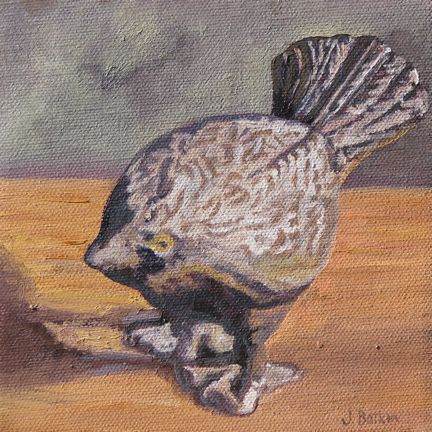
MA’s little iron birds are back home with her, and now she has this little guy too! That was a fun one. 😎
MA’s little iron birds are back home with her, and now she has this little guy too! That was a fun one. 😎
When teaching people how to draw, sometimes it is difficult to articulate my thoughts. A picture is worth a thousand words, and sometimes a thousand words still can’t explain the picture. Often, I can’t find the right word, so I will make one up. The funny part is that my students understand the meaning!
A woman was working on some boulders but something wasn’t looking believable. The problem was that she had inadvertently drawn potatoes and an oversized pinto bean! We figured out how to turn them in to rocks, and then she asked how to draw some grass behind the boulders. I was trying to keep her from making a lot of little lines all in a perfect row. Remember the bird “Woodstock” in the comic strip Snoopy? His word bubble had a lot of little vertical lines. To help her not make Woodstock word marks, the instructions came out, “You need to sort of bounce your clumpage along – that’s it, just horizontalize it a bit more”. She got it.
Some folks have taken lessons so long that I have become a habit to them. I tell them they don’t need lessons because they know how to draw. They tell me that unless they pay their monthly fee, they will not carve out time in their lives to draw. While they draw, we talk about art, drawing and life.
Truthfully, I love my students – we become friends, comrades, buddies in the artworld. I show them my art and give them the freedom to tell me anything they think about it, good or bad. We speak truth to one another and try to use known English words. It is helpful and refreshing and sometimes, it can be hilarious!
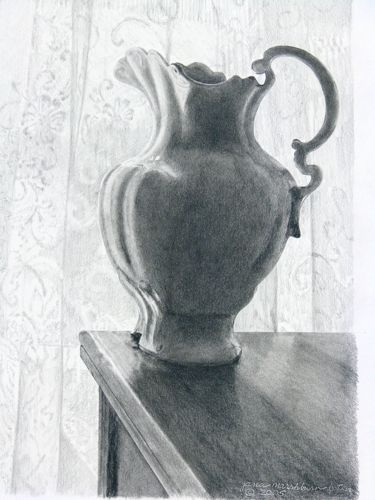
Swirls – 11×14″ – pencil
It isn’t popular in the artworld to admit that one works from photos. In fact, the closest you’ll get to reading that someone works from photos is “I use them for reference”. Brings to mind something Jack White, my painting inspiration/guru/mentor said – “All realistic painters either work from photos or they lie about it”. Me? I TOTALLY work from photos – if I just use them for reference, it is because the scene was so complicated that I just started making things up!
The other JB and I visited the Buckeye campground in Sequoia National Park over the weekend. There is a mellow little trail that leads to a picturesque footbridge over the main fork of the Kaweah River. (You can read about it in the January 17 blog post.) When JB saw the view, she burst forth with the declaration, “If you paint that, I will buy it!” Being a hard-nosed business tycoon (snort, guffaw), I said, “Okay, I will show you some sketches first so you can see if you like it and after I paint it, I won’t hold you to buying it.” (Jack White would not be pleased with me for that!)
Here is the main view that JB was so taken with; you can barely see the bridge in the photo! This is why I will have to sketch things in advance of painting – how large can I make the bridge without distorting reality? How much rock, if any, in the foreground is actually necessary? Can I “grow” the river, because in our memories, it is The Main Event?
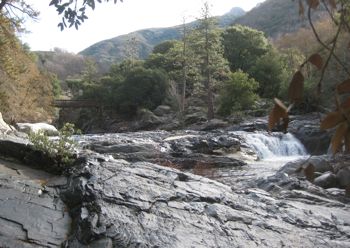
All these photos will be useful to create a small (“thumbnail” in Artspeak) sketch that will determine what size and where each part should be in proportion to the other parts. If I was carrying a backpack that day, a sketchbook would have been a helpful item. But I am a modern chick who uses a digital camera with tremendous gratitude for the technology.
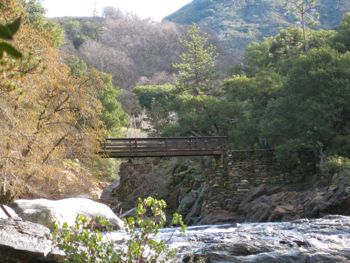
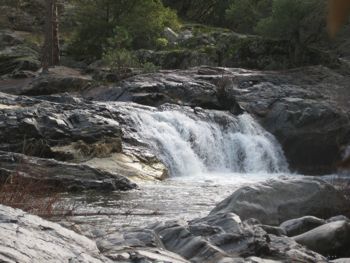
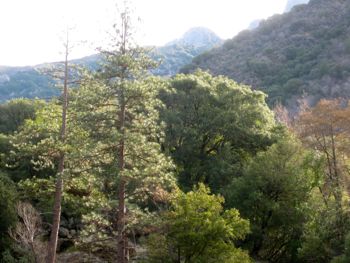
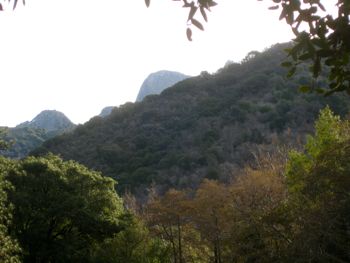
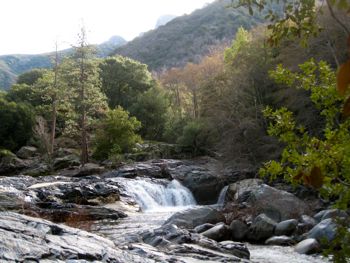
Pictures tell stories in less time than words and I need time to paint. 9 down, 7 to go! (Show coming in May. . . more will be revealed.)
In college, an art professor said to me, “Just because you can draw doesn’t make you an artist”. I was devastated, insulted, dismayed, shocked, and any other adjective you can think of for the situation – how dare he say that to me!! Now that I have the advantage of life experience and wisdom, I know he was right, even if it was an insensitive and snotty remark. His point was that there is more to making art than simply drawing.
Master of Fine Art, or MFA, is the highest degree possible in art. My college professors may have had their MFAs but mostly they walked around the room while taking a break from their own work, and offered criticism and snide remarks (”Just because you can draw. . .” or “You need to work on composition”) without ever bothering to actually teach, to demonstrate or share information.
I have been teaching people how to draw for 16 years without an MFA. Drawing is a skill, and in teaching the skill, many other things about art can be shared. We talk about different styles, ways to set up a drawing from the beginning, ways of arranging the elements in a drawing, and lots of technique. First I show how, then I explain why.
Through the years, only two of my students that I can think of have pursued art as a career. Everyone who has stayed long enough to learn to draw has learned to draw, and they each have drawings they can proudly show off to prove that they know how to draw. Even without going into art full-time, learning to draw has give each one confidence.
A year or 2 ago I saw 3 former drawing students. Louis was in the Navy, Stephanie was thinking about occupational therapy, and Mark was a cowboy. Drawing lessons were not a waste of time for any one of these wonderful young folks – they learned to draw (duh), learned to communicate with people of all ages (that is the way my classes are arranged), explored a type of art in a comfortable environment, got to display their work in a show or two, developed a bit more confidence, and made new friends.
I enjoyed every moment spent with each of these people and love seeing how they are turning into adults. We have an easy friendship that transcends age and that has lasted through time and changes. They can draw; are they artists? I think so! And I am an artist in addition to being a teacher and being able to draw, so there, you Snotty Professor who is now probably just a retired teacher!
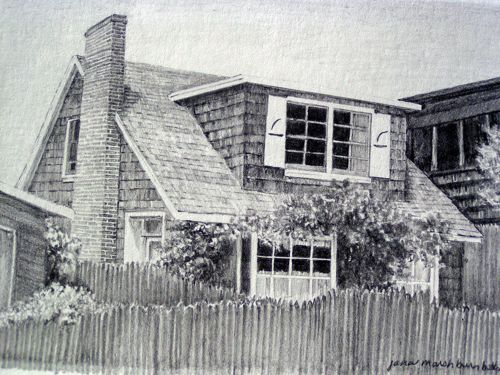
The Beach House, graphite, 10×8″
private collection
Diane commented on my post “The Rules” about Professor 6B and it was funny. Made me realize I had lapsed into a bit of jargon, so here is some clarity for you all. And here is a weird thing – not a single art teacher taught me any of these basics. I learned about them from digging around on my own. Sure, a person can draw without knowing all this stuff, but it is better to know about one’s tools than to just bumble along, particularly if one calls herself a professional!
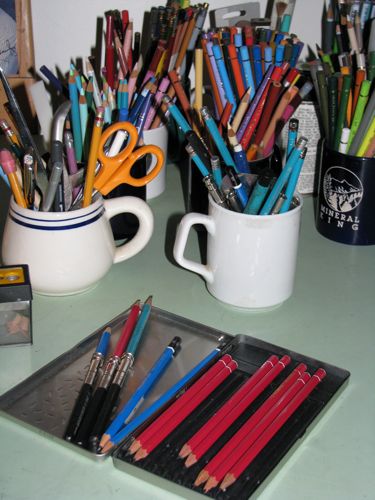
First, I no longer have all those mugs of pencils on my desk. The colored pencils are in a basket on a shelf overhead. Every so often I have a Clutter Attack, and stuff starts flying out the door. Having unused things, no space, too much stuff in general just bugs me. I’ve mentioned before that I may have whatever is the opposite of that Hoarding problem.
Pencils are not made of lead but the writing part is still called a “lead”. They are made of a combination of graphite and clay: the more graphite, the blacker and softer the lead; the more clay, the lighter in color and the harder the lead. Differing manufacturers combine these things in different percentages, but they all use the same rating system. B = black, H = hard. The higher the number with the letter, the stronger that particular quality is. So, a 6B is blacker than a 4B. A 5H is harder than a 2H. HB is dead center – I’m guessing 50% graphite and 50% clay. If it has only H on it, that is the equivalent of 1H. They assume we will figure that out. (Ditto for B.)
Pretty straightforward, but then some of those manufacturers have to throw a monkey wrench in the simplicity of the system with a pencil called “F”. Excuse me?? I used to think it stood for “funky” because it didn’t fit into the rating system. Turns out it stands for “fine” because it can be sharpened to a fine point. So can every other pencil, so I fail to see the point. Oops, a pun. It seems to be about the same hardness as an H.
The softer/blacker pencils get used up much more quickly than the harder ones. I still have my original 6H from a college art class, although the lettering is worn off the casing. If you drop one of the softer pencils on concrete, you might as well put it in the trash, because it will be broken all the way through and the lead will fall out in little pieces every time you sharpen it. I can hear the collective “aha” as you all realize you have experienced this annoying phenomenon.
One last piece of trivia – those #2 pencils required by test givers to fill in the bubbles are the same as HB. If you look closely at the words on the casing you might even find “HB” written there. It remains a mystery to me why there are 2 rating systems for pencils.
Perhaps next time I will write about erasers (and the lack of them on drawing pencils).
Ever wonder what an artist does on a day off? I only know what one artist does on a day off – that would be me. First, I experience a tad bit of anxiety about not working when there are deadlines and lots of work right here at my home studio. In a concerted effort to not work, I read some knitting blogs instead of websites about how to use Facebook to benefit my business. Then I decide that it would be rude to work when Michael is off and at home; besides, during the week when it is sunny out, I keep wishing I could be out in the yard.
After all this reasoned thought, I was ready to face the day. We spent the morning pruning and hauling brush and being amazed at the vast quantities of materials that grow in our yard and aren’t edible. . . which is why they grow here and aren’t consumed by deer and gophers. After a short lunch break, Michael suggested a walk. I’ve been watching our neighbor’s dog and the poor beast is lonely, so I thought we should go visit him.
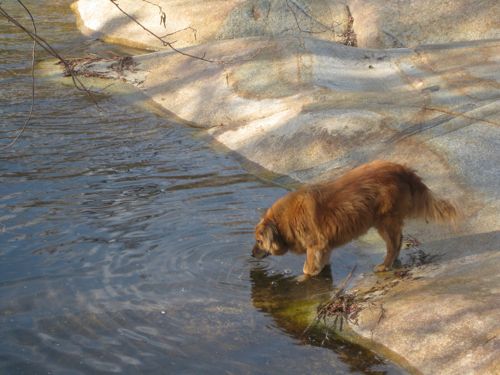 This is Berkeley Jones, adopted from an animal shelter about 9 years ago and given his unusual moniker by 2 sweet little girls, one of whom will be getting married next summer.
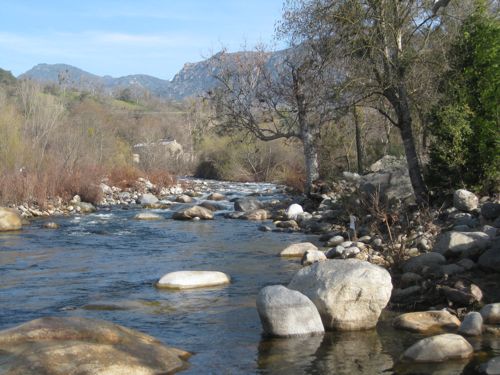
There was more incentive to check on Berkeley than simple concern for his well-being; he has a beautiful back yard!
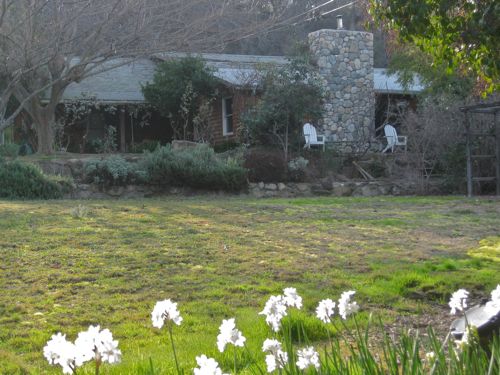
We walked back home with a profound sense of gratitude for life in Three Rivers, in the sunshine above the fog of the Central Valley, walking distance from the river, surrounded by great friends and beauty in every direction. (Never mind about the weak water system in our neighborhood which caused us to abandon 75% of the lawns that came with our house; that looks like a crummy lawn in the photo, but it is a weed patch now.) We were also inspired by the very fine manicured oaks in Berkeley’s yard so we spent another couple of hours in the yard when we got back home, trying to keep up with the (Berkeley) Jones!
Recently my friend MA sent me some info about painter Abbey Ryan, and I watched a video of her painting. She finishes one painting every day and then sells it for big $ on eBay. It looks so easy.
MA owns these cute little metal birds. She loves these guys, and I understand why!
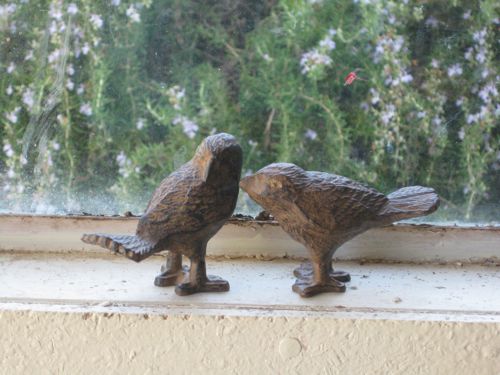
She asked me to paint one for her on a 6×6″ canvas. I photographed them a bunch of different ways, this angle, that angle, 2 together in different poses, light on this side, light on that side, this one alone, that one alone. Then I deleted the ones that weren’t as appealing, cropped the 4 best ones to a square format, emailed her, and let her choose. She asked for one more angle, so I photographed it that way and sent her favorite along with the new one. She chose the first favorite.
I began mixing the colors while looking at the actual birds. The sun was so bright that I was sure I was getting the colors perfect! Mixing colors is so much fun, and it is sort of magical because of starting out with only 2 blues, 2 reds, a yellow and white.
Finally, it was time to paint. I couldn’t get the angle of light on the bird the way it was in the photo, and the light was too bright to see my computer screen photo well. I moved things all over my work area, and finally decided to just begin. I figured I could try getting MA’s bird finished in one sitting a la Abbey Ryan. I figured wrong. The brush is still not a pencil, no matter how much I practice. Finally I realized that the paint was just smearing around, messing up the colors, and no more progress would be made until it dried. Here is how the little bird looks after one painting session:
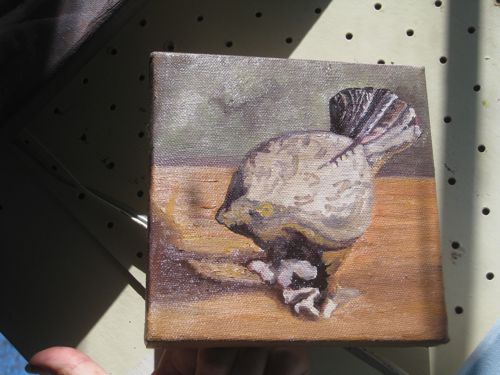
Good start, messed up feet, paint all over my hands from holding the canvas!
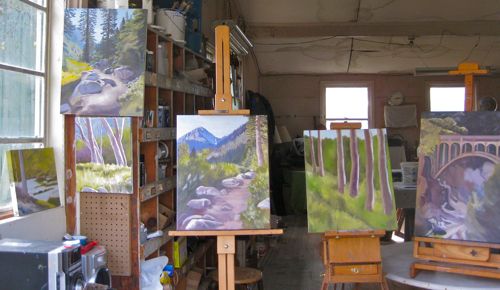
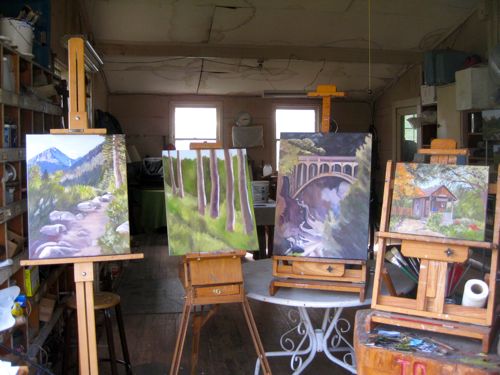
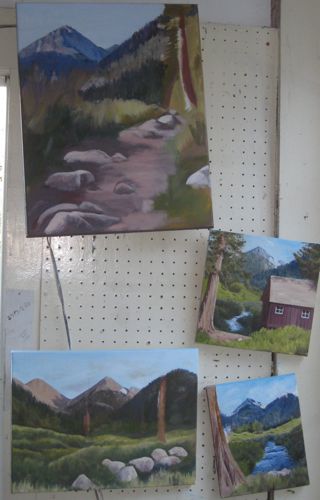
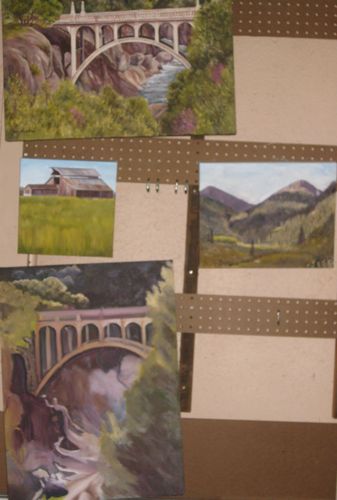
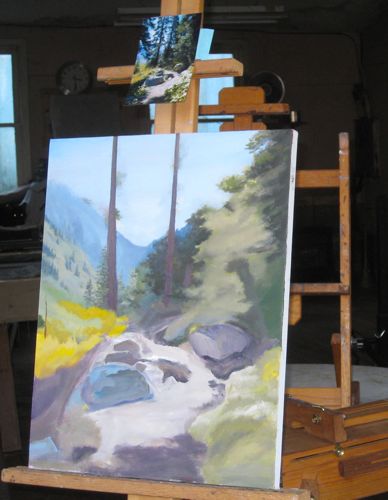
Still rotating around the workshop among the many paintings in progress. At some point I may stop showing you these, because I want you to attend the show at the Tulare Historical Museum. And, when you attend, I want you to say “WOW!” rather than “Oh yeah, I saw that one while it was being painted”. Not sure when that point will be reached. More will be revealed. . . or hidden, in this case.

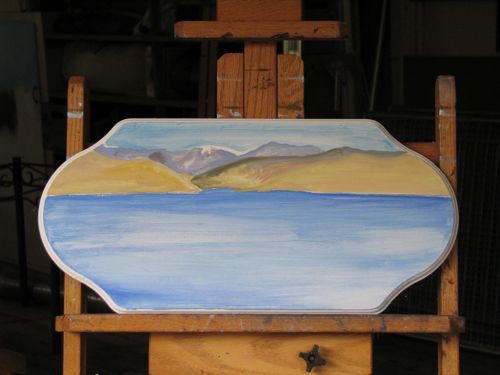
This is a sign for a houseboat. The customer brought me the sign form and I had to design a few choices for her, including a typestyle that she liked. (I didn’t name the boat!) She chose a design that looks as if it is a scene rather than just a strict lettering project. This was a challenge on several fronts – painting on wood, painting on an unusual shape, figuring out how to do lettering without it looking like my own handwriting or looking machine-like. Here is the beginnings of the project:
Here is the finished project:
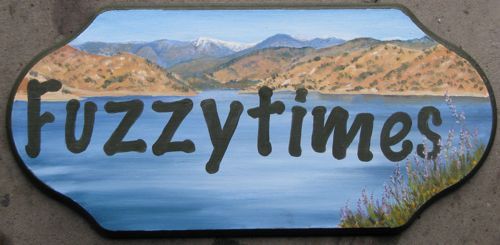
In case you were wondering, I sort of “bounced” the letters a little for a playful look – with a name like “Fuzzytimes”, it seemed to require a bit of extra playfulness!