Hypocritical Artist

I am a hypocrite. I tell my drawing students to not attempt to draw faces smaller than eggs and to never draw from photos that are too fuzzy to see, because IF YOU CAN’T SEE IT, YOU CAN’T DRAW IT! (Yes, often said in all capital letters and sometimes even with a bit of bold thrown in for extra emphasis.)

The author/customer needs drawings because his only photos are not good. A drawing is better than a poor photograph. But, if I can’t see it and the faces are smaller than an egg, what’s an artist to do? I want to help the customer – that’s my job!
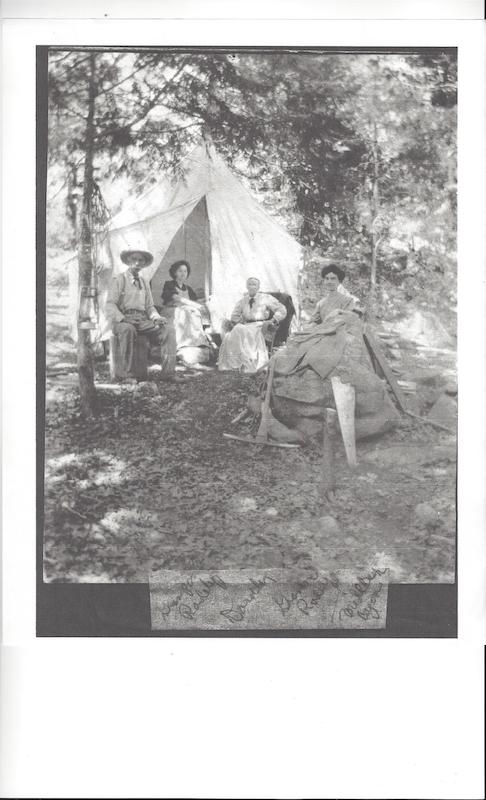
The answer is I work really hard. I focus, adjust, erase, add, erase, adjust, study, think, erase, et cetera. All work is done with a giant magnifying glass with a special light bulb, and strong magnifying glasses, along with very sharp points on my pencils.

Here are Henry and Dora at their tent above Springville, living there in hopes that Dora’s tuberculosis will be cured.
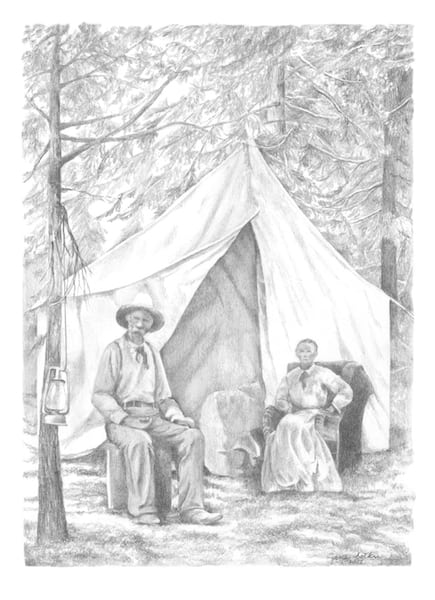
For the rest of the story, you will have to buy the book. But first, it has to be written, edited, rewritten, formatted and then printed. 

It may be awhile. . .
More Can’t See ’ems

If I can’t see it, I can’t draw it. But sometimes I try anyway, because I want to help the customer.

Besides, “If I can’t see it, I can’t draw it”, my other set-in-stone rule is, “No face smaller than an egg”. I learned this from a very accomplished colored pencil portrait artist, Ann Kulberg. She wasn’t speaking of a hummingbird egg, and I find that even a normal chicken egg size is a challenge.

Think about this: in the size of an egg, the width of one pencil point off in shading someone’s eye can make her look like her cousin. There is no forgiveness. None.

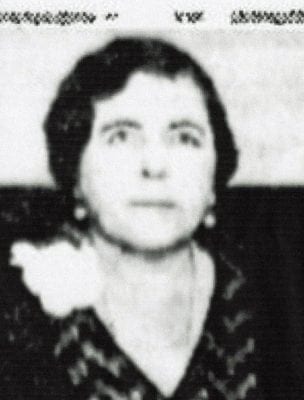
So, what did I do when a customer brought me this photograph and asked for a pencil drawing of it, minus 2 of the people?

Be merciful to me, a shameless hypocrite.

Stay tuned. . .


Can’t Draw It If You Can’t See It

“If you can’t see it, you can’t draw it”, is one of the regular things I say to my drawing students.

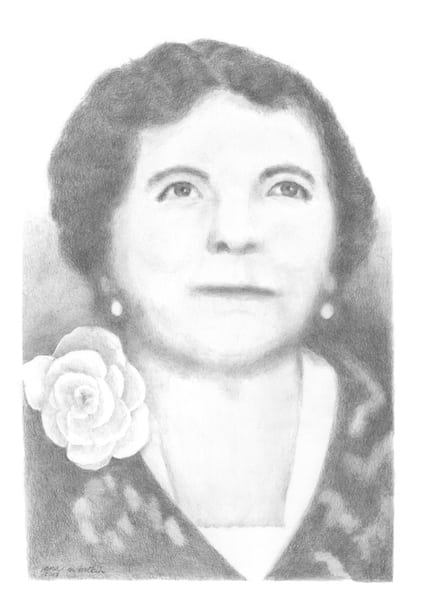
Along came an author, writing on local history, seeking someone to illustrate some pictures in his book. He wanted drawings because several of his photos are awful, and he wisely thought it better to have a good drawing than a poor photo.

My students and I have gotten a good laugh about my accepting this job. Portraiture is my least favorite subject. There are such subtle differences between faces, and if you can’t see it, you can’t draw it.

However, there is no one left who knows what Edythe Tate Thompson looked like, and this is the only known photograph of her. So, I did my best to make her look pleasant and human, although she may have been super-human. She was responsible for bringing the tuberculosis hospital to Springville, and responsible for getting Julia Morgan to design the first building.

I don’t think I captured an exact likeness. She looks happier to me in the drawing, more approachable. Maybe her face is a touch too wide, maybe her mouth is; I think I’ve put her eyebrows farther apart If you knew Edythe and have a photo of her, let me know.


8 Things I Learned in September

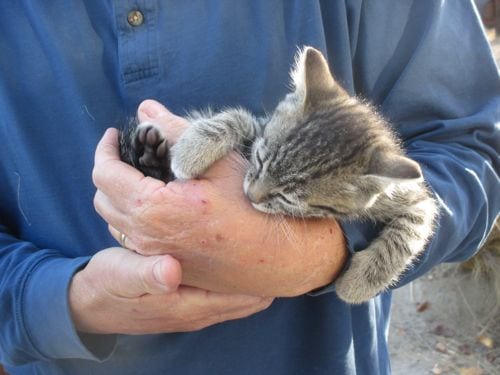
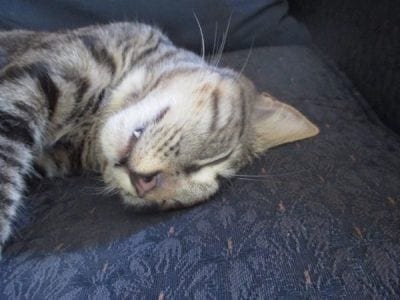
Still biting us after a year, although he is much larger now, Samson the Bengal wanna-be.

These are life things I learned mostly in September, although a few may have spilled over from late August.

  1. An Americano is espresso with hot water added. I can’t tell the difference between that and a cup of black coffee. My nephew is employed by Starbucks and informs me that Americanos suck. Not sure why this is his assessment.
  2. A dog will eventually eat food it doesn’t like rather than starve; a cat will become anorectic. Samson actually ate some dry food for the first time in the past couple of months, so maybe his tastes are changing; he is a year old now.
  3. Some people never do figure out where they fit in personality profile tests; I may be one of them. Just finished reading Anne Bogel’s Reading People, which is an overview of different personality typing tests; it was helpful, even if my main conclusion is that I don’t know who I am. I’ll keep learning. . .
  4. No matter how much I use InDesign and Photoshop Elements, they just keep confounding me. Adobe and Apple have been compared to a couple after a bad divorce; I come down on the side of Apple every time.
  5. If bread doesn’t rise very well, it will take longer to bake; conversely, if it rises very well, it will get done much sooner than expected.
  6. A battery powered drill can also be called an “impact wrench”–say what? Must be man talk.
  7. Crystal Pepsi is a thing. It tastes good. I almost never drink soda of any kind, and a friend gave me one of these to try. I have no idea if it tastes like real Pepsi or not. Because I don’t drink soda, the sugar and caffeine really packed a wallop!
  8. Drawing lesson for me: when shading by layering with pencils, with a heavy hand, you’ll get your darkest blacks by beginning with the blackest pencils; with a lighter hand, you’ll get your darkest blacks by ending with the blackest pencils. Maybe. Haven’t cemented this yet, even after years and years of drawing and teaching drawing.

Sawtooth Peak Oil Painting Continued

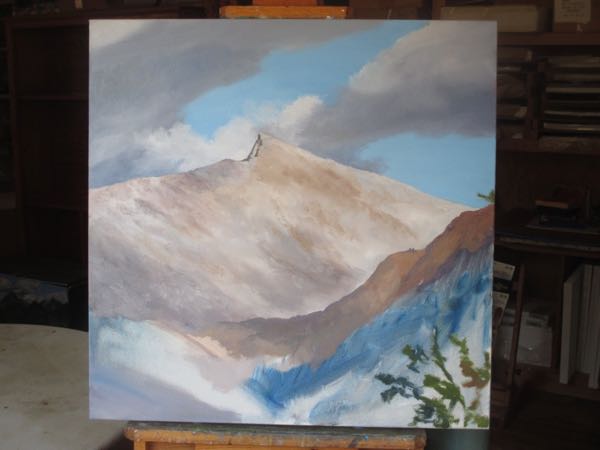
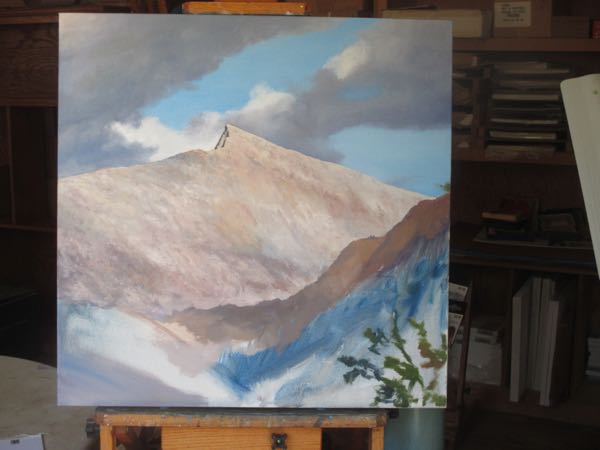
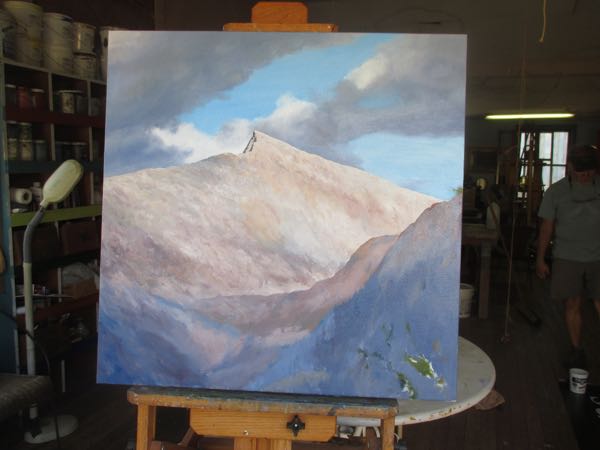
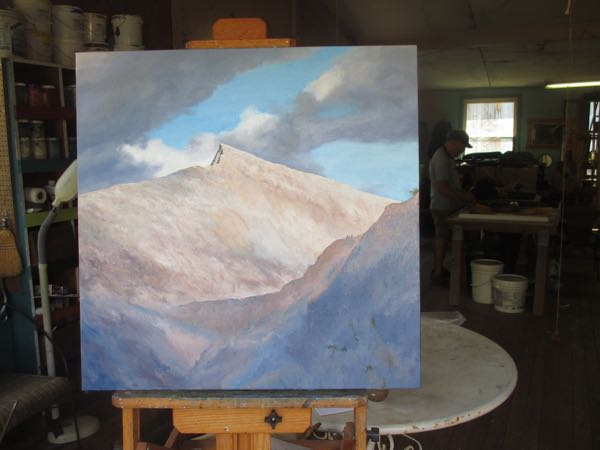
The layers continue to build on Sawtooth Peak, an oil painting.

As it was when you last saw it:

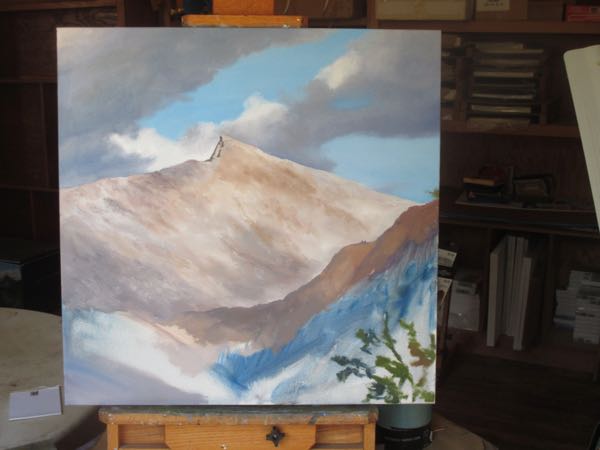
Another layer added to the sky:Another layer added to Sawtooth:

Another layer added to the lower ridges:

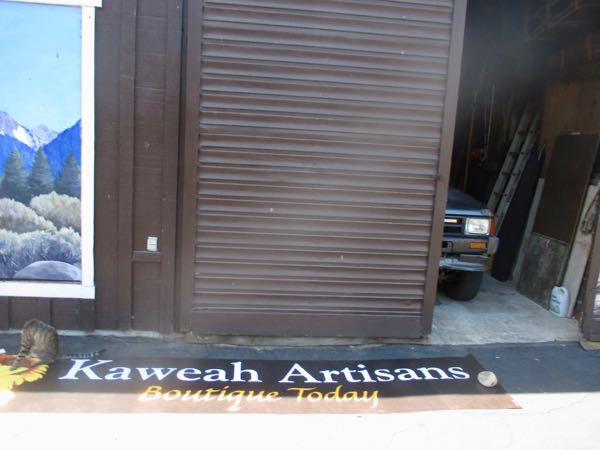
And more added to the lower ridges:Yo, Professor Layer, may I be finished with the sky and the peak and the lower ridges now? (Can you see Trail Guy’s visor in the background as he adds grommets to the Kaweah Artisans banner?)
When this dries, I’ll put in branches at the bottom edges. I think this wants greenery, or maybe it is fine as it is. . .

What do you think??


Kaweah Artisans

Kaweah is the name of the river (rivers – it is THREE Rivers) in town. Artisans are people who make specialty stuff; more precisely “workers in a skilled trade who make things by hand”.

For about 18 years I have been part of a group called “Kaweah Artisans”. We do shows, which we prefer to call “boutiques”, 2-3 times a year. We change venues, and our membership fluctuates. 

The rules are one maker per medium, be different from the crowd, be professional, and know how to display well. So, if you make something cool but not cutesy, are professional in your conduct, approach to business and display, and we have no other item maker in your category, we’ll take it to The Committee and decide. If your items meet the criteria and our space is not too crowded, The Committee will probably say yes. (But not if you have a reputation as a jerk; this is a very small town within a small county, and life and business are hard enough without personality complications.)

When I joined, there was a florist, a jeweler, a jam maker, a photographer and a weaver. Only the weaver and I remain of the original group. For our next show, we will be joined by a jeweler, a gourdista*, a cosmetic maker, a photographer, a small sculptor, a potter, and a chocolatier.

We still have our original banner, looking tired and worn out. It was time to update things.

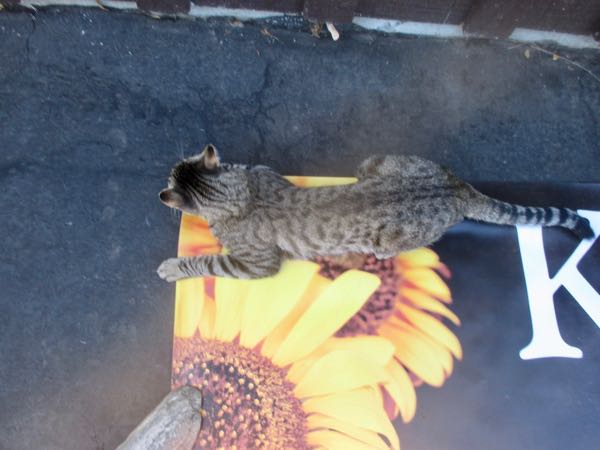
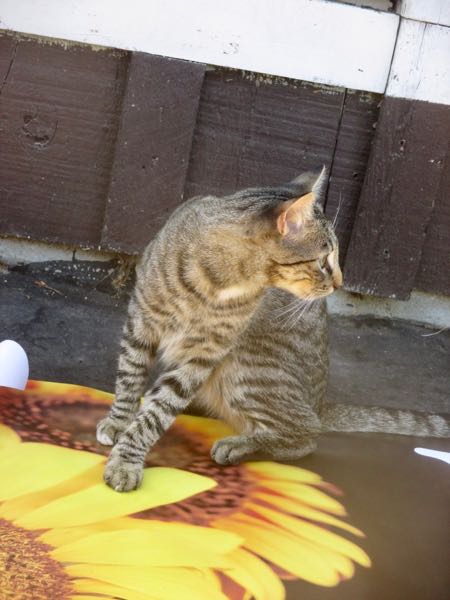
When the banner arrived, I unrolled it outside to see how beautiful it is. Samson helped.

I FORGOT TO ORDER IT WITH GROMMETS!! The local hardware had them.

THE VINYL WAS TOO HARD TO PUNCH THROUGH! Our neighbor lent a hole punch.

And, Trail Guy put them in!

Kaweah Artisans marches on with lots of help from our friends, neighbors, family and pets. Our next boutique will be on the Friday and Saturday after Thanksgiving.

*Do you like the word “gourdista”? I just made it up.

You Know You are Middle-aged When. . .

Rapid Change*, pencil drawing, title indicative of life as a middle-aged being

An older and wiser friend reminds me from time to time that life is like a roll of toilet paper–the closer to the end, the faster it goes.

I’ve been thinking lately that you know you are middle-aged when. . .

. . . you prefer hiking uphill to downhill because your knees kill you going downhill.

. . . you choose not to watch a movie because you don’t want to shuffle 3 remote controls and don’t understand why it is even necessary.

. . . your pastor, doctor and the president are all younger than you. (Not so with the current president, in case you were wondering.)

. . . you go to your class reunion and can’t find your friends among all the old people.

. . . you know the words to the orchestrated songs in the grocery store.

. . . you notice young people driving too fast instead of old people driving too slow.

. . . you recognize the word “update” as a euphemism for “complications and trouble ahead”.

Do you have anything to add to this list?

*Rapid Change is available for sale here.


Book Shepherd

What is a book shepherd?

One who guides or “shepherds” a book from an author’s idea to final printed version. If you have ever written a book, you might know that feeling of, “Now what am I supposed to do to get this published?” A book shepherd guides the author through the options and steps of ending up with a well-written and well-printed book.

My learning about book shepherding began with self-publishing The Cabins of Wilsonia. I was my own contractor, doing all the research, photography, drawings, book design, book formatting, computer work on the drawings, and finally finding a printer. I hired a self-publishing consultant, an editor for the written parts, and had 4 friends proofread for me. (NO ONE should EVER do a final edit on one’s own writing or EVER pretend to be able to proofread one’s own work – it parallels the saying “He who represents himself in court has a fool for a lawyer”.)

This experience woke up something inside of me that said “BE AN EDITOR – YOU DO IT ALL THE TIME ANYWAY!” (Yes, it shouted at me in bold and all capital letters.) IT is something that manifests as a Typo Psycho, and causes me to twitch whenever I read most self-published books, if I can even get through the first big error of “Forward” instead of “Foreword”. These self-publishers tend to be ignorant of the parts of a book; their books are full of redundancies, run-on sentences, unnecessary and boring topics, poor grammar, typos, and horrible formatting. They bring to mind a description from my friend Jennifer: “Loving hands at home”, not meant as a compliment.

People who have a story to write need help. There is so much more involved than writing! I want to help.

When I first heard “book shepherd”, I realized that I had done this already; even though it was just for myself, it counts. My experience allowed me to share my new-found knowledge with Louise Jackson on her book Trail of Promises. This book turned out so beautifully that Louise asked me to help her with The Visalia Electric Railroad. We are nearing completion and the light at the end of the tunnel is an oncoming train book.)

There were more books I helped on along the way in various capacities, but this post is getting too long already. It probably needs a good editor.

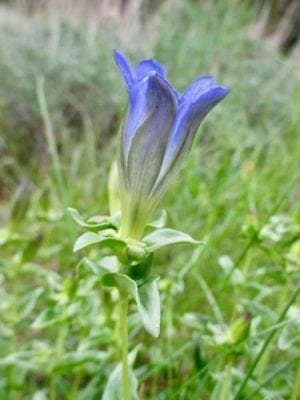
You deserve a nice picture after wading through these thoughts. This is my favorite wildflower, Explorer’s Gentian.


I’ve Been Working on the Railroad

I’ve been working on The Visalia Electric Railroad: Stories of the Early Years with Louise Jackson. Books take a ton of work AFTER the writing: a lot of talking, editing, tons of computer time, decisions, decisions, decisions, emails, phone calls, meetings, more editing, proofing, more decisions. And it is all very fun, especially when you get to work with people you love.

One of my tasks as Louise’s book shepherd is to gather photos and make them usable for the book – change all the mysterious computer things, clean up the fuzz and hairy stuff and tears and stains, resize them, and figure out where they belong in the book.

Yep, book shepherd is a real job, and it is what I did for her Trail of Promises book and am doing for The Visalia Electric Railroad. There is another book by another writer coming soon, but I won’t be telling you about that until January or so. 

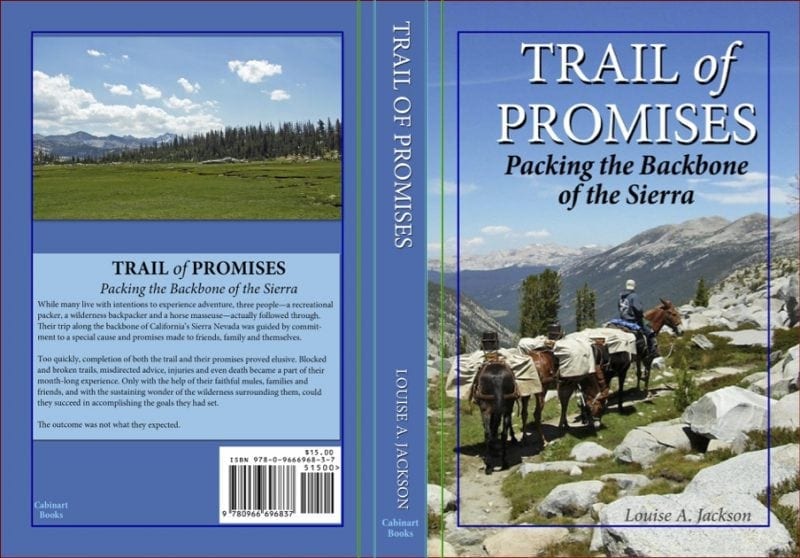
Time out for a quick commercial: Trail of Promises: Packing the Backbone of the Sierra is available here. Here is the entire cover as it would look if the design guidelines didn’t show, and if you smashed the book flat and open. (This is not recommended behavior.)

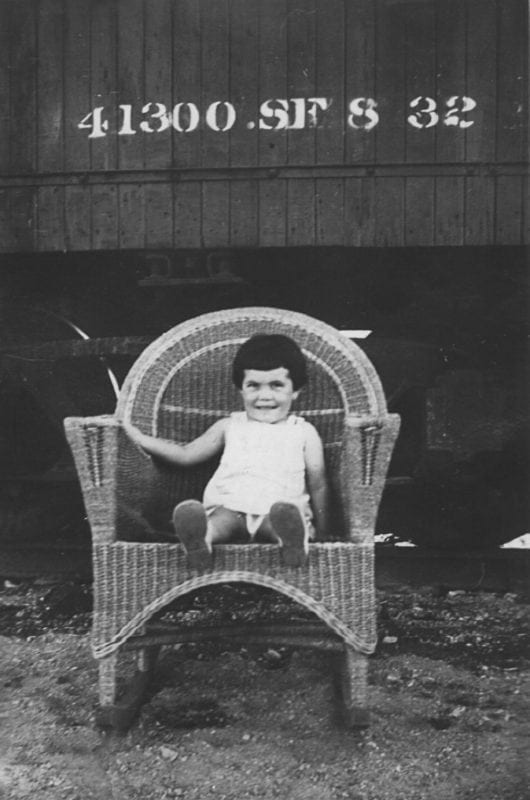
But I digress. Have a look at a photo that won’t be in The Visalia Electric Railroad. There will be a similar photo, but this is too precious to not show you.

Hi, Mom!

What’s the Problem?

Problem? There is no problem. Why do you ask?

Oh. Because I’m not posting as regularly. Because today is Friday and there is nothing about Mineral King.

After Labor Day, my real life resumes. I don’t go to Mineral King as often, because there isn’t as strong a need to escape the heat. My workload picks up, and drawing lessons begin again. Or, maybe I just miss Samson and want to stay home more. (He’s not dead, just dead to the world).

I’ve been working on the railroad. . . sing along now!

Couldn’t help myself. Sorry.

I’ve been working on a book with Louise A. Jackson. It is The Visalia Electric Railroad: Stories of the Early Years.

This book was first published by the Tulare County Historical Society. When they ran out of inventory, they asked Louise if they could get it reprinted. She said yes, but she wanted to rewrite some of it, correct some things, have me do her editing, work with me on the photos (the previous printer did not do any justice to the old pictures), and have me do the formatting so we could print it as a proper paperback in 6×9″ instead of as an 8-1/2 x 11″ book with staples in the center.

So, we’ve been working on the railroad, and more will be revealed in the fullness of time.