What You Really See

As we learn to put on paper what we really see instead of our symbols, it is shocking to learn how much is really there and how it is really shaped or sized. Drawing upside down is one tool; tracing the basic elements and only looking at the tracing instead of the photo is another tool. Another way to simplify what is in front of our eyes is to squint, and the detail fades.

You saw an example of Farewell Gap as it was interpreted by someone who didn’t see or chose to ignore reality. Here is a drawing I did of Farewell Gap a long time ago when I was still bound to photos. It was such a thrill to put on paper exactly what I saw that I didn’t have any interest in editing or creating. I was lost in the joy of “I CAN DO THIS!”

This is not the actual photo from which I worked – 1994 is too long ago for me to be able to put my hands on that exact piece of paper! However, here is the photo of Farewell Gap for comparison purposes:

C Words

Eighth in the series “Thoughtful Thursdays”

(yes a bit out of order – why WordPress didn’t publish this as scheduled is a mystery to me. Why I didn’t notice is perhaps because I was doing other things – I need people for this!)

Two of the most common ways to earn a living in art are consignment and commissions. They are not at all the same, but I am discussing them here in the same article because those two large “c” words are often confused.

Here are the definitions: consignment is an agreement to pay a supplier of goods after the goods are sold. A commission is an order or authorization for the production of a piece of art.

Consignment means that the artist provides the store or gallery with work that is not paid for until a sale is completed. The advantages to the artist are that she doesn’t lose control of her pricing and can reclaim her work if it is needed somewhere else. The disadvantage is that things can become shopworn, keeping track is added work, and sometimes it can be hard to collect one’s money.

Commissions are orders for custom work. This is a very important part of earning a living as an artist, especially in times when people are spending cautiously. The advantages to the artist is that she is almost guaranteed a happy customer, and there is a check waiting at the end of the job. Two disadvantages are that the artist isn’t freely creating from her own ideas and often there is a deadline. Occasionally a commission customer will say these magic words “You’re the professional!” or “No hurry”.

Since we are learning “c” words here, allow me to add one more: conversation. This word means an exchange of words, not orders and not money. Despite repeated experiences with this reality, my greatest talent still remains counting my chickens before they hatch.  For the first several years of my business, I got so excited when someone told me he’d like me to do a specific drawing for him. I was counting eggs, chickens and dollars, forgetting that until money exchanges hands and there are photographs on the table, it was simply CONVERSATION. It never hurts to remember those chats and even follow up with a phone call or an email. That is also part of the business of art.
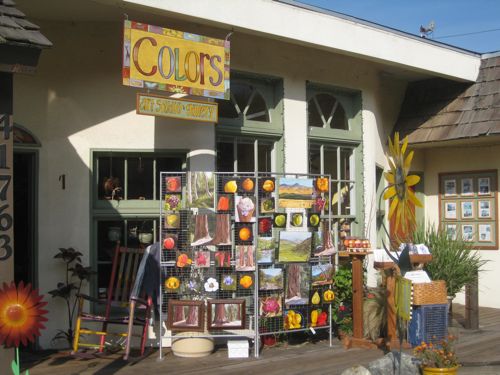
Colors in Three Rivers sells some of my paintings on consignment.
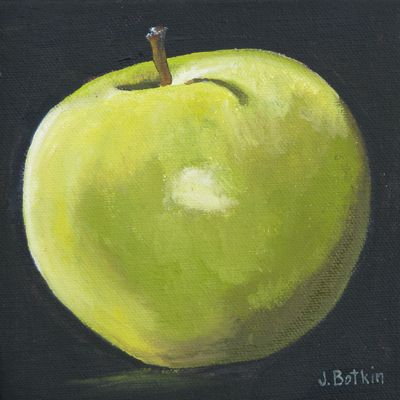
A lady of great taste commissioned me to paint this apple.
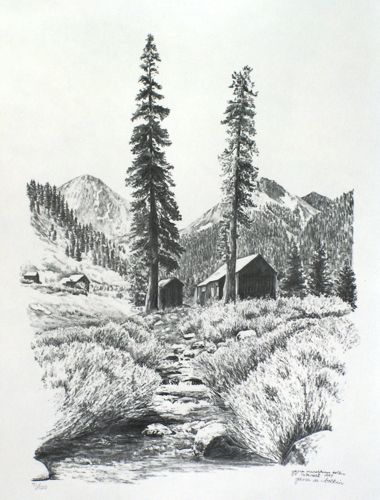

Commission

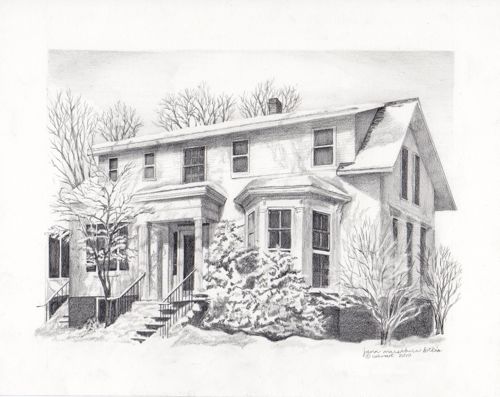
Remember this word? It means “an order for something to be produced such as a work of art”. Indeed! A friend of a long-time customer contacted me with a request to draw a house. The photos came next-day type post and had to be signed for. There were three and they had obviously been peeled from an old album. None of the three had a complete view of the house; two were from the front and one from the side. There was snow, and changes had been made from the 70s photo to the more current one. Have I mentioned lately that I love to draw? I LOVE to draw, and this challenging puzzle was greatly satisfying!

Love to Draw!

All summer I have been in conversation and planning for a drawing of a cabin. It has grown from a simple drawing to a collage, and the very trusting and polite customers have given me freedom to do it anyway I want. Often, the customers like to participate in the planning and be given a few choices and have a little input. These folks have taken a different approach, and it is a tad bit nervous-making, and quite a bit of fun! Here is what is completed as of today:

img_5291.jpg

It just takes me back to my roots of pencil, commissioned work, and, well, cabinart!

A Pair of Minutes, continued

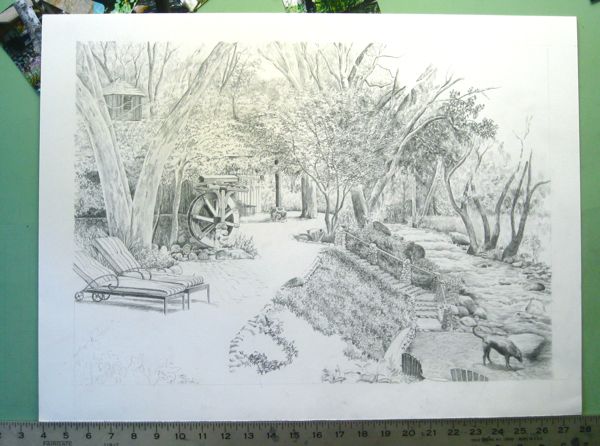
Amazing how much work can be accomplished when one sits down, removes distractions, picks up the tools and works for just a pair of minutes! You can see how this very large drawing is nearing completion:

img_5290.jpg

The right side of the water wheel, brick pavers, some ground cover and a few detailed flowers in the foreground are all that remain. But wait! There’s More! – the final step in all drawings is the “nit-picking”, also known as the refinement stage. This is when little changes are made that cause a significant improvement – darkening the darks, lightening the lights, increasing contrast in the important places, sharpening the edges on some areas and blurring out others.

Gaposis

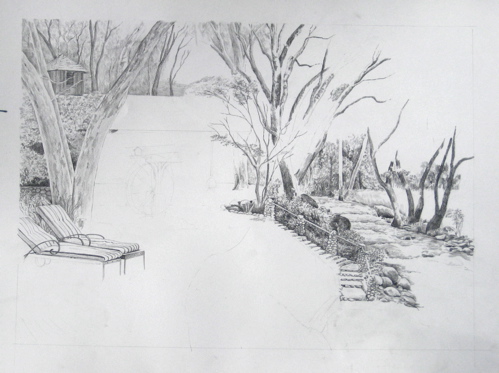
Back in the day when I used a real camera, a complicated drawing might take 2 rolls of film. Now that the restraint of “wasting film” has been obliterated, I take as many photos as I want! It is such a nice thing to never stop to change rolls. Despite the abundance of images, there are always more needed. That is why there is a large gap in the middle of this drawing.

gaposis.jpg

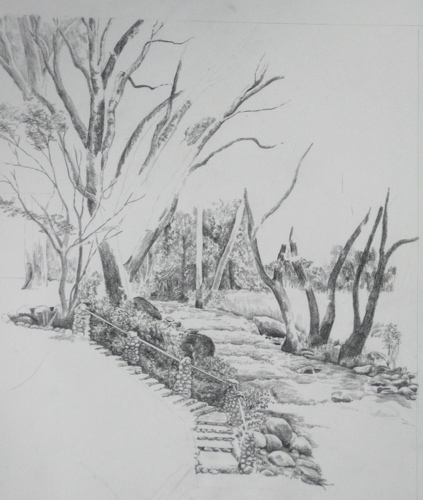
Here is the right side so you can see a bit more detail. The stone steps are so beautiful that I forget to admire the (unfinished) river!

drawing.jpg